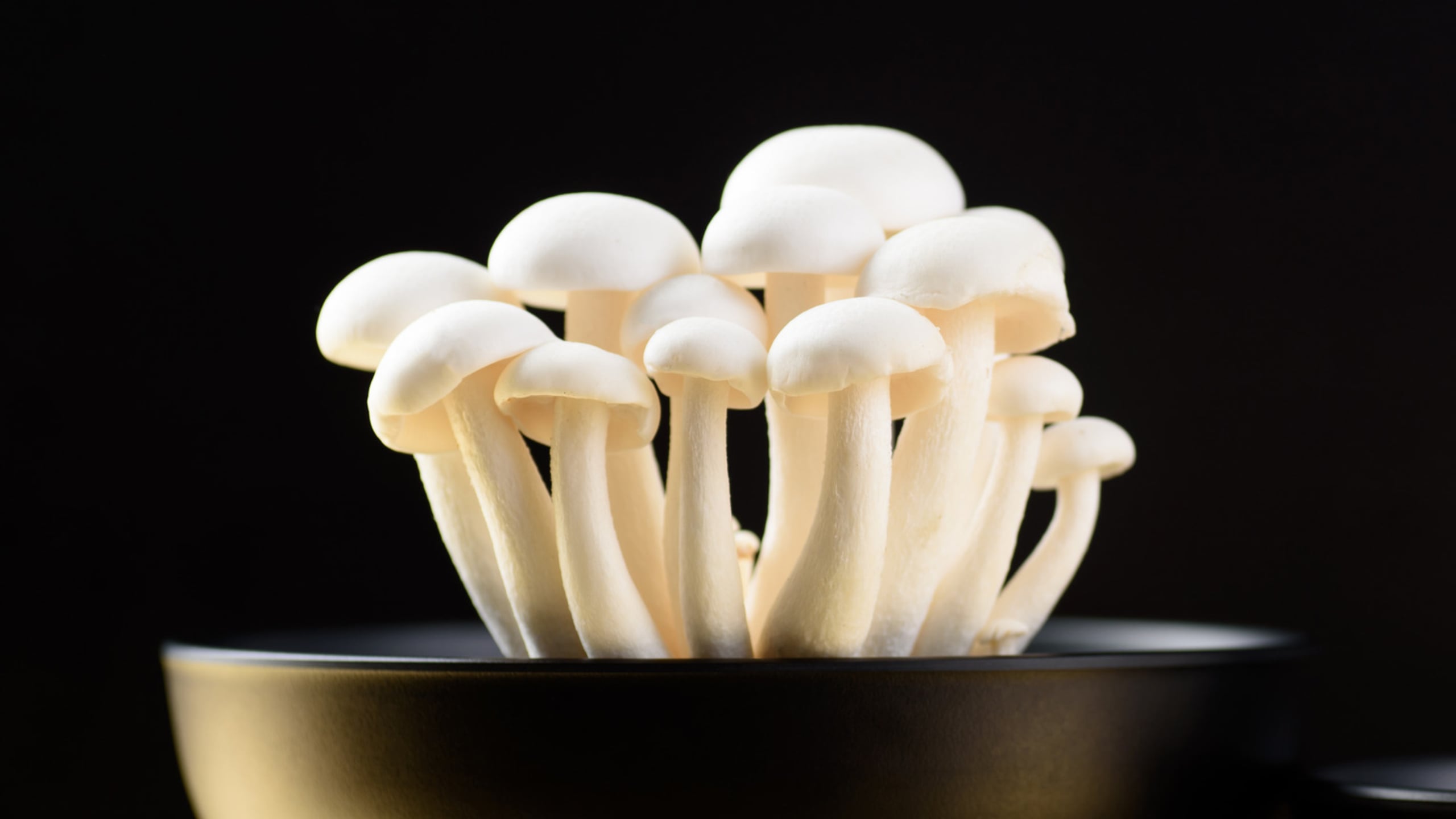
Researchers in China have identified three short protein fragments from the edible beech mushroom that intensified the salty taste of salt solutions in laboratory testing, ScienceAlert reports. The strongest of the three raised perceived saltiness by roughly 71 percent compared with a solution containing the same amount of salt alone. The study, published in npj Science of Food, was led by scientists at Gannan Medical University and Shanxi Medical University.
The finding points toward a possible route for seasoning foods that keep their salty character while carrying less sodium, though the work remains at an early, experimental stage.
Why it matters
Public health guidance is built around cutting sodium. The World Health Organization advises adults to take in under 2 grams of sodium per day, which works out to less than 5 grams of salt. Too much sodium raises blood pressure and with it the risk of cardiovascular disease.
The difficulty is that lowering salt changes how food tastes, which makes healthier versions harder to sell to eaters. ScienceAlert notes that researchers have already tested other approaches, including a large trial showing benefits from swapping regular salt for a blend with less sodium and added potassium. The mushroom study asks a different question: whether an added ingredient can make the salt that is already in a food register more strongly.
From mushroom protein to five candidate molecules
Peptides are short chains of amino acids, the units that make up proteins. Some carry tastes of their own, including umami, the savory note linked to mushrooms and other foods. Certain umami peptides are also known to sharpen the perception of saltiness, which is what drew the team to the beech mushroom, Hypsizygus marmoreus.
To isolate promising molecules, the researchers used enzymes to break the mushroom proteins apart and then separated out a fraction containing smaller fragments. Among the enzymes tested, trypsin produced the strongest saltiness under the study's conditions.
The analysis turned up 6,092 peptide sequences. Testing each one by hand would have been impractical, so the team turned to computational screening. They filtered the sequences for predicted traits such as solubility, stability, toxicity, and allergenicity, and used machine learning to flag those likely to deliver umami. That process left five candidates to synthesize and put in front of tasters. The predictions served only to rank the molecules, ScienceAlert reports; they did not establish that any of them would be safe as a commercial ingredient.
Human tasters and a 71 percent jump
The sensory work involved 14 trained assessors between the ages of 19 and 34, who evaluated samples using a sip-and-spit method. Reference solutions helped keep their ratings consistent.
For the saltiness comparison, each peptide was added at 1 milligram per milliliter to a solution holding 3 milligrams of sodium chloride per milliliter. A control sample contained the same salt level with no peptide added.
Three peptides stood out: ASHGEGF, LDDGF, and GDDWT, with the letter strings naming the amino acids in each. ASHGEGF lifted the saltiness rating by 70.59 percent. LDDGF and GDDWT raised it by 49.02 percent and 47.06 percent respectively.
One point the researchers stress is what that figure does not mean. A 71 percent gain in perceived saltiness is not the same as removing 71 percent of the salt. Both the test and control solutions held identical salt concentrations, and the study did not determine how much sodium could be cut while leaving taste untouched.
The effect also lingered. In fitted taste-intensity curves, saltiness lasted 75 seconds for the plain solution and 105 seconds once ASHGEGF was added. The other two peptides stretched the sensation to 90 seconds.
An electronic tongue, which reads chemical samples through electrical signals, added supporting evidence. It registered higher saltiness readings for all three mixtures than for the plain salt solution.
A possible mechanism, not a proven one
Seeking an explanation, the team built computer models of TMC4, a membrane protein tied to salt taste. The simulations indicated the peptides could form stable associations with the modeled protein, mostly through hydrogen bonds.
That does not confirm what happens inside human taste cells, but it offers a hypothesis worth pursuing. Salt perception runs through several pathways, and the authors say more receptor studies and cell experiments are needed.
The researchers also acknowledge practical unknowns. Other ingredients, cooking, and storage could all affect how well the peptides perform. They plan to test them in real low-sodium foods and to assess their sodium-reduction potential, sensory effects, and stability in practice.
For now, no one has shown that adding these mushrooms to a pot of soup would reproduce the experimental result. The tests used specific synthesized peptides rather than whole mushrooms, and the setting was water and salt rather than a finished dish.
In their paper, the researchers describe the work as proposing a screening strategy for saltiness-enhancing peptides from Hypsizygus marmoreus and say it supports their potential as taste enhancers for low-sodium food applications.
The next step is to learn whether the effect holds up outside a simple solution. Watch for follow-up trials in actual low-sodium foods, where safety, stability, and usefulness at realistic concentrations will decide whether three small molecules can turn into a working ingredient.





