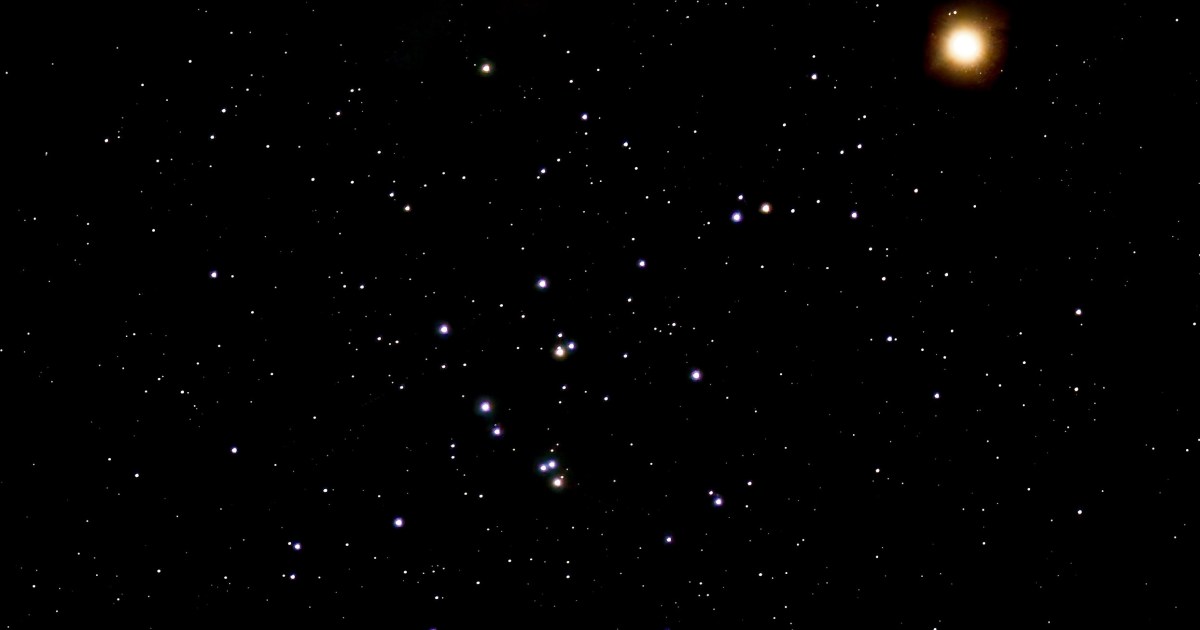
Mars is moving through the Beehive Cluster in the constellation Cancer early Sunday morning, according to Astronomy.com, offering skywatchers a chance to watch the planet drift among the cluster's stars. The planet shines at magnitude 1.1 and rises around 1 A.M. local daylight time, Astronomy.com reports, reaching about 30° above the eastern horizon by 4 A.M.
Why it matters
The Beehive, also known as M44, is a nearby open cluster that has been recognized since ancient times. Astronomy.com notes it has carried several names over the centuries, including Praesepe, Latin for manger. Its stars together shine at magnitude 3.7, which puts the cluster within naked-eye range from a dark site, where it looks like a fuzzy patch of light roughly 100 arcminutes across.
That combination — a bright planet and a cluster visible without equipment — makes this an accessible event. Observers do not need a telescope to take part, and the pairing gives a clear demonstration of how much faster a nearby planet moves against the background sky than the distant stars behind it.
Watching Mars move in real time
Binoculars or a telescope of any size will sharpen the view, according to Astronomy.com, revealing the orange planet set among pinprick white and blue stars. Within about 10 minutes, observers can begin to notice Mars shifting position relative to the cluster, because the planet appears to track across the sky while the more distant stars stay fixed. Astronomy.com suggests making a few sketches or taking photos over the course of an hour to make the change unmistakable.
The event has drawn coverage from several astronomy outlets. Sky & Telescope included it in its weekly sky roundup for October 9 through 18, while BBC Sky at Night Magazine and Starlust.org both highlighted the crossing as one of the weekend's notable sights. Astronomy.com also featured it in its own week-ahead guide for October 9 through 16.
Jupiter, the Moon and Venus in the same sky
Mars is not the only planet on display before dawn. Lower toward the horizon, bright Jupiter leads the constellation Leo upward, Astronomy.com reports, sitting near the boundary the Lion shares with Cancer. The two planets can be captured together in a single wide-field nightscape photograph.
Venus is a harder target. The Moon passes 3° north of Venus at 11 P.M. EDT, but Astronomy.com notes that neither body is above the horizon at that moment. The pair sets just minutes after sunset, so Venus is effectively out of view. The crescent Moon, however, can be spotted in the west as the Sun goes down.
For observers at 40° N, 90° W, Astronomy.com lists sunrise at 7:07 A.M. and sunset at 6:26 P.M., with moonrise at 8:13 A.M. and moonset at 6:38 P.M. The Moon is a waxing crescent at 2 percent illumination, measured at 10 P.M. local time from that location.
The article was written by Alison Klesman, a senior editor at Astronomy magazine who holds a Ph.D. in astronomy and has studied subjects ranging from minor planets to supermassive black holes.
Skywatchers hoping to catch the crossing should plan for the hours before dawn, when Mars is highest in the east and the Beehive is best placed for viewing.





