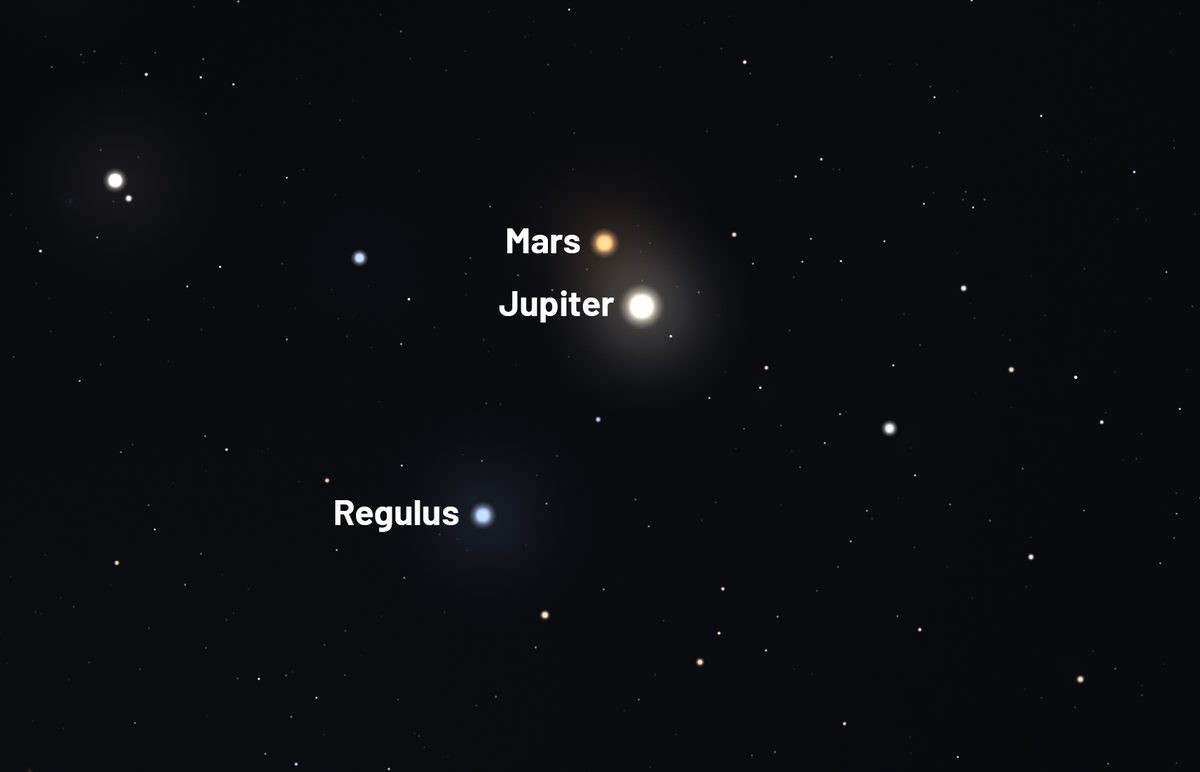
Mars and Jupiter are moving toward a close meeting in the pre-dawn sky during November 2026, according to BBC Sky at Night Magazine. The pair have already been appearing as two bright points in the southeast before sunrise, and they will keep closing the gap until their closest approach, expected around 14-17 November. The Moon also passes through the grouping at both the start and the end of the month.
Why it matters
Planetary conjunctions give casual skywatchers a reason to look up and give experienced observers a chance to track how the sky changes from one morning to the next. BBC Sky at Night Magazine notes that photographing the arrangement on several clear mornings will show how quickly the positions shift.
The event also pulls in Regulus, the brightest star in Leo, so three objects of different brightness share a small patch of sky. Jupiter outshines the others at magnitude –1.9 early in the month, Mars is dimmer at +0.9, and Regulus is faintest at +1.3, the magazine reports.
How the grouping shifts night by night
At the beginning of November, Mars and Jupiter sit 5.7° apart, which BBC Sky at Night Magazine compares to the width of three fingers held together at arm's length. Together with Regulus, they form the western half of a belt-like line of objects.
On the morning of 1 November, the Moon is 57% lit and sits 7.5° west of M44, the Beehive Cluster. From the UK, the Moon passes in front of the cluster later that day, after both have set. BBC Sky at Night Magazine points to a better opportunity to watch the Moon cover the Beehive on the night of 28 November.
By the morning of 2 November, the Moon has thinned to 46% and moved nearer to Mars. Regulus, Jupiter, Mars and the Moon then line up in a roughly evenly spaced row. A day later, the 35%-lit crescent sits just south of the halfway point between Jupiter and Regulus. On 4 November, the Moon begins to leave the group.
Mars then takes over the main role, sliding north of Jupiter by about a degree on the mornings of 14-17 November. During this window Mars brightens slightly to magnitude +0.7 and Jupiter reaches –2.0, according to the magazine.
A triangle that keeps changing shape
Mid-month, the three objects form a tight isosceles triangle. In the days that follow, the shape alters noticeably as Mars continues east past Jupiter and edges toward Regulus. On the morning of 22 November, all three fit inside a circle less than 4° wide. By 26 November, Mars has moved to the opposite side and now forms the narrow base of a second isosceles triangle, this time with Regulus.
The pattern remains visible into the first days of December 2026, when the group rises before midnight Universal Time, BBC Sky at Night Magazine reports.
Other outlets have also flagged November as a busy month for skywatchers. National Geographic listed eight night-sky events for the month, including a supermoon and three meteor showers, while the Saudi Press Agency highlighted four planets, meteor showers and a large full Moon. Noozhawk columnist Dennis Mammana described Mars, Jupiter and the Moon as putting on a pre-dawn display.
For those hoping to follow the conjunction, BBC Sky at Night Magazine suggests taking photos on clear mornings and comparing them over time. The magazine is inviting readers to send their images and observations to [email protected].
Watch for the tightest pairing around 14-17 November, then keep an eye on the changing triangle as Mars overtakes Jupiter and heads toward Regulus through the end of the month.





