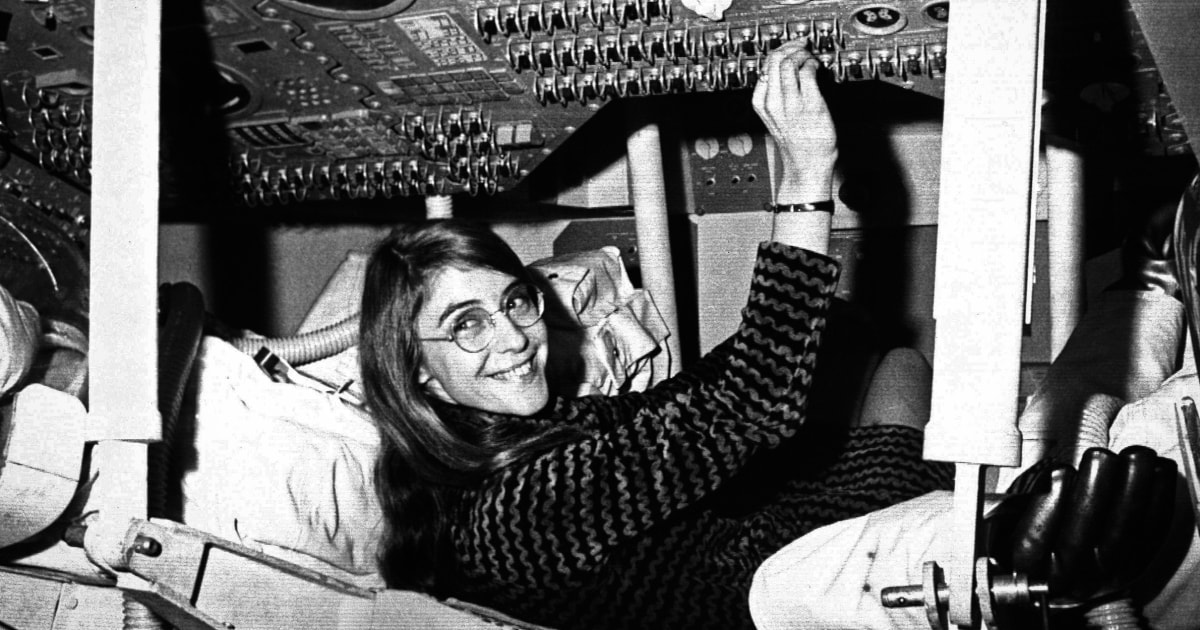
Margaret Hamilton, the computer scientist who directed the team that built the onboard flight software for NASA's Apollo missions, died Sept. 30 at a hospital in Cambridge, Massachusetts, according to NBC News. She was 90.
Her daughter, Lauren Hamilton, confirmed the death to The Associated Press on Thursday. NASA Administrator Jared Isaacman said on the social platform X that Hamilton's work helped make humanity's first trips to the moon possible, NBC News reported.
Hamilton spent years at the Massachusetts Institute of Technology, where she began in 1959 after earning a mathematics degree from Earlham College in Richmond, Indiana, the previous year. Her earliest MIT work included weather prediction software developed with a meteorology professor, according to MIT News.
Why it matters
Hamilton's career sits at the origin point of software engineering as a discipline. She led a team writing code for one of the most complicated systems anyone had attempted, at a moment when the field had almost no established practices, said Olivier de Weck, the Apollo program professor at MIT and interim head of its aeronautics and astronautics department.
De Weck told MIT News that calling Hamilton a pioneer understated her role. He said she wrote advanced code herself and also guided a team applying a young technology to a system of extraordinary complexity.
Her public profile grew sharply in her later years. A photograph of a smiling Hamilton in her early 30s, standing beside a stack of printed code taller than she was, spread widely online. A Lego set honoring the women of NASA, released in 2017, included a Hamilton figure. The 50th anniversary of the Apollo 11 landing in 2019 brought another wave of attention, her daughter said.
Lauren Hamilton told the AP that her mother went from being largely unknown to being recognized by nearly everyone, particularly within her own field. She said her mother was glad to receive credit for her contributions, though the attention did not come naturally to someone with a reserved temperament.
From weather models to the command module
Hamilton joined MIT's Instrumentation Lab in the mid-1960s, at a time when the lab held a NASA contract tied to Apollo. She first worked on software for missions without a crew aboard, then moved to leading the group that developed the flight software for missions carrying astronauts. By 1968, according to MIT News, she was assistant director in charge of the command and service module team.
Reflecting on the period in a 2009 interview with MIT News, Hamilton said she and many colleagues began the work while still in their twenties and treated it as serious business. She described devising solutions and new approaches as an adventure.
She also recalled that because software struck senior managers as an unfamiliar black box, her team received unusual latitude. In her account, leadership trusted the group completely and left it to find its own way forward.
That freedom mattered, because the software had to function under conditions no one could fully rehearse on the ground. The Apollo guidance computer ran aboard the spacecraft, and its programs had to support navigation, guidance and control tasks during a mission. Hamilton's team wrote the code that astronauts depended on in flight, and the systems her group produced became part of the infrastructure that carried crews to the lunar surface and back.
Her path into that work ran through mathematics rather than a formal computing curriculum, which barely existed at the time. She arrived at MIT a year after finishing college and moved from meteorological modeling into the space program as Apollo ramped up. The arc from weather prediction code to crewed spacecraft software traces the rapid expansion of what computers could be asked to do in a single decade.
A symbol for women in computing
Hamilton's story also became a reference point in discussions about who built early computing. The New York Times framed her legacy as predating the era when computer science hardened into a male-dominated field, noting that she wrote code before that shift took hold. Her visibility made her a recognizable figure for women entering technology, a role reinforced by the Lego tribute and by anniversary coverage of Apollo 11.
The recognition arrived decades after the work itself. For much of her career, the software that supported Apollo drew far less public notice than the rockets and spacecraft it ran on. That changed as historians and journalists revisited the program and as the image of Hamilton beside her team's printed code became one of the most shared artifacts of the Apollo era.
Her daughter's account suggests Hamilton accepted the late attention without seeking it. Lauren Hamilton described her mother as someone who was pleased to be acknowledged but not especially comfortable at the center of public interest.
Hamilton's death was first reported by NBC News, drawing on confirmation from her family. Tributes came quickly from the institutions and agencies connected to her work, including MIT, where she spent the formative years of her career, and NASA, whose administrator credited her contributions with enabling the first human voyages to the moon.
What happens next: memorial arrangements have not been announced, and the Apollo program's remaining software artifacts and archival records will continue to be studied as part of the historical record of early spaceflight computing.





