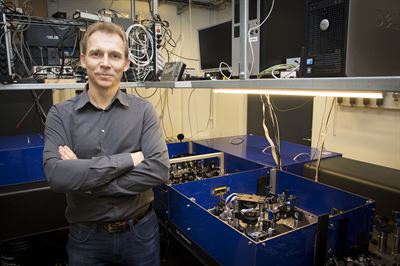
Researchers at Lund University in Sweden have observed every stage of photosynthesis inside a living organism for the first time, according to Cision News. The work, carried out at the university's chemistry department with partners in the United Kingdom and Canada, was published in the journal Proceedings of the National Academy of Sciences under the title "Charting light harvesting in purple bacteria in vivo."
The study centers on how light energy travels through the photosynthetic machinery of purple bacteria, following the process step by step as the organisms photosynthesized. Donatas Zigmantas, a chemistry professor at Lund University, said the details of what happens immediately after sunlight is absorbed had until now been difficult to examine closely.
Why it matters
Photosynthesis underpins nearly all life on Earth. The process allows plants, algae and certain bacteria to take in sunlight and convert that energy into chemical form. Cision News reports that scientists have studied it for a full century, so its broad principles are well established. What remained out of reach was the fine-grained sequence of events at the very start.
The new findings also carry a practical angle. Zigmantas said that learning how nature gathers and converts solar energy could inform the design of better and more durable solar cells and other technologies that draw on the sun's power.
A new window into a fast process
To get around earlier technical obstacles, Zigmantas and his colleagues built a new spectroscopic method suited to this kind of measurement. With it, the team could watch light energy move through each stage of photosynthesis in living purple bacteria, Cision News reports.
The researchers traced the energy's path from the moment sunlight is absorbed, through the molecular antenna that captures it, and onward to the reaction center where the captured energy becomes chemical energy. Zigmantas said this had never been observed before.
The approach differs from studying isolated components in a laboratory dish. By working with living organisms, the team could see how the parts of the system behave together as a whole.
Near-perfect efficiency at the start, modest results overall
The study reveals how effectively the different parts of the process cooperate, according to Cision News. Zigmantas described photosynthesis as a robust process shaped over billions of years of evolution.
He said the opening steps often proceed with a quantum efficiency close to 100 percent. In this context, that means nearly every photon — each particle of light from the sun — is successfully converted into an electron within the system.
That figure applies only to the beginning of the process, during light absorption itself. Across the entire chain of events, the overall efficiency falls far below that of the best solar panels currently on the market. Cision News reports that such panels convert just over 25 percent of incoming energy, while photosynthesis comes in at roughly 4 percent.
Zigmantas pointed to another quality that sets the natural system apart: it is highly robust and can repair itself. It tolerates changes in its surroundings, and when something breaks down, it can often mend on its own.
The gap between the two efficiency figures does not make photosynthesis a poor performer in every respect. Its resilience and self-repairing behavior are properties engineered systems do not yet match, which is part of why the researchers see lessons worth extracting.
What to watch
The study has been published in PNAS, and its method may open the door to similar measurements in other organisms. Watch for follow-up work that applies the same technique beyond purple bacteria, and for efforts to translate what the team learned into new solar technologies.





