No astronauts flew on Artemis I, but two mannequins rode aboard the Orion spacecraft fitted with hundreds of radiation sensors as part of the Matroshka AstroRad Radiation Experiment. A paper led by Paweł Bilski of the Institute for Nuclear Physics of the Polish Academy of Sciences, published in the journal Radiation Measurements, reports the experiment's results, including how a new kind of long-term passive monitor built from lithium performed, according to Universe Today.
Why it matters
Once a crew leaves the shelter of Earth's magnetic field, it faces cosmic radiation made up of a very wide range of atomic nuclei, from fast-moving hydrogen protons to heavy lead ions travelling close to the speed of light. Biologists gauge the hazard of these particles with a measure called linear energy transfer, which describes how much kinetic energy a charged particle deposits into matter. Heavy ions dump large amounts of energy over a very short distance, and that is what causes biological damage along their path.
Knowing the dose is one problem. Knowing what kind of radiation delivered it is another, and that second question is what the new detector was built to answer.
How the crystals work
Plastic nuclear detectors have done this job for years. Typically made from polymers such as poly-allyl diglycol carbonate, known as CR-39, they record a cosmic ray as a physical tear. Back on Earth, researchers have to soak the detector in hot sodium hydroxide for several hours to etch it, turning the damage into cones and pits that can be measured under an ordinary microscope. The process destroys the detector, produces hazardous waste and needs specialised labour.
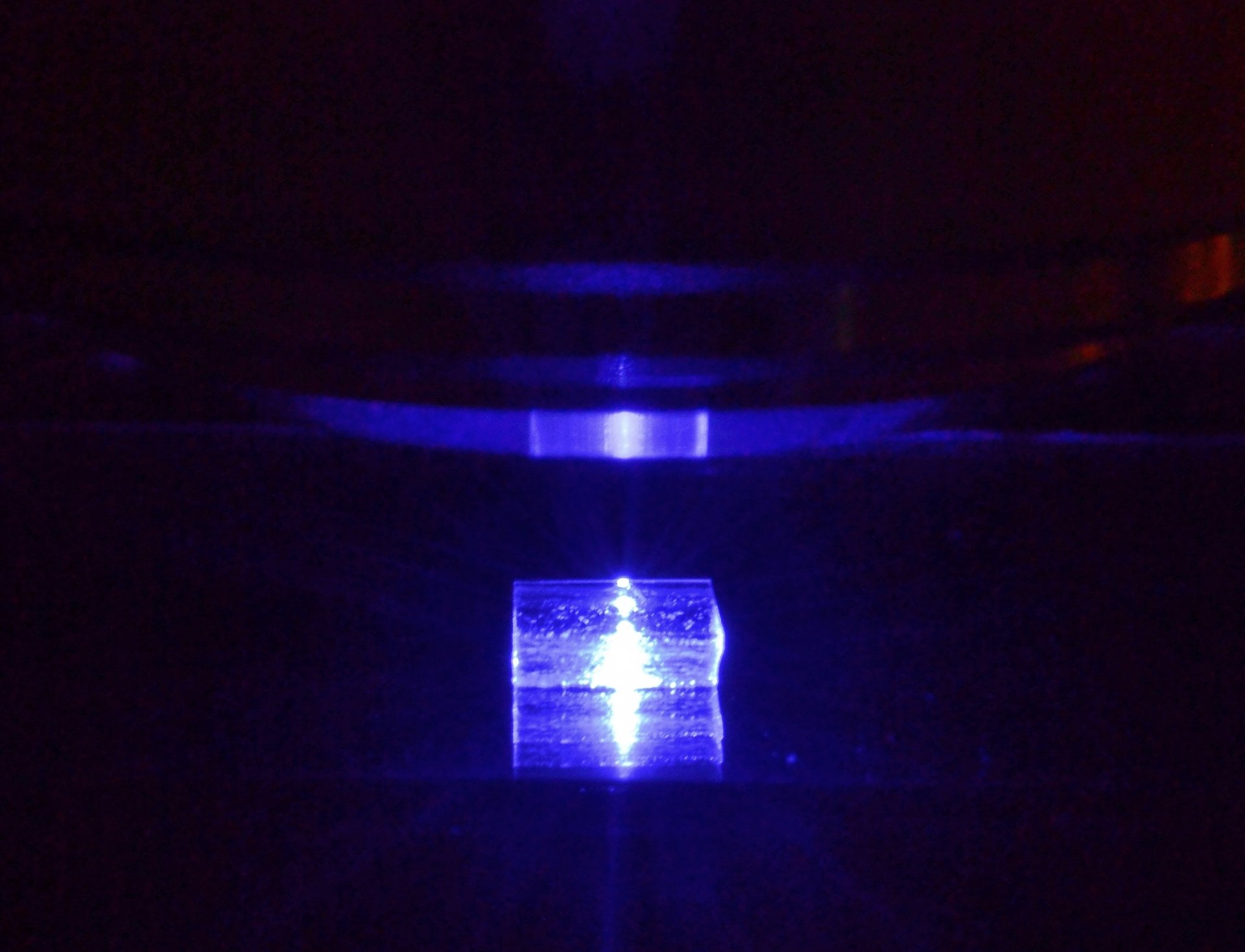
Bilski and his colleagues tried a different route: millimetre-sized crystals of lithium fluoride, which are known as fluorescent nuclear track detectors. Rather than punching holes in plastic, incoming particles knock electrons loose in the salt's crystal structure, forcing the lattice to change and leaving behind a lasting optical mark called a colour centre. When a laser is shone through the crystal under a microscope, those colour centres glow blue along the path the particle took.
That sounds straightforward, but deep-space radiation arrives from every direction, which makes it hard to tell where individual rays came from. A microscope can only focus at one depth, and light from layers above and below the focal plane bleeds into the image. The team also had to separate particles that crossed the surface perpendicularly, which show up as single bright points, from those that merely grazed it, leaving longer, fainter streaks.
To sort this out, the researchers built a mathematical framework to reconstruct the full energy spectrum of the radiation delivered during the experiment. They stacked microscope images taken just a micrometre apart and followed the tracks through the whole crystal. For intermediate energy transfer, the approach worked well, and the results matched the traditional plastic detectors mounted alongside the crystals on Zohar, one of the mannequins.
A calibration gap at high energies
At high energy transfer, the two detector types disagreed. The new sensors overestimated the dose by roughly 30%, and the researchers suspect the cause lies in the nuclear physics of the fluoride crystal itself. Occasionally a high-energy secondary neutron strikes a lithium nucleus inside the detector and knocks that atom out of alignment, producing its own glowing track that can be mistaken for a radiation trail.
To limit the effect, the team ran a series of test crystals made with lithium-7, which is intended to suppress those secondary reactions. The researchers set aside data from natural lithium detectors for this reason; lithium-7 does not eliminate knock-on collisions but does reduce them.
Despite the calibration difficulties, the paper is described as a step forward for passive dosimetry in space. That capability is expected to matter more as missions move toward longer stays on the Moon and other deep-space destinations carrying real astronauts rather than mannequins. Detectors of the kind tested on Artemis I should give flight surgeons a clearer picture of what crews face once they spend extended periods beyond the reach of Earth's magnetic field.
The next step to watch is how the lithium-7 approach and the track-reconstruction method are refined and flown again, since the high-energy discrepancy will need to be resolved before the technique can be relied on for crew dose planning.





