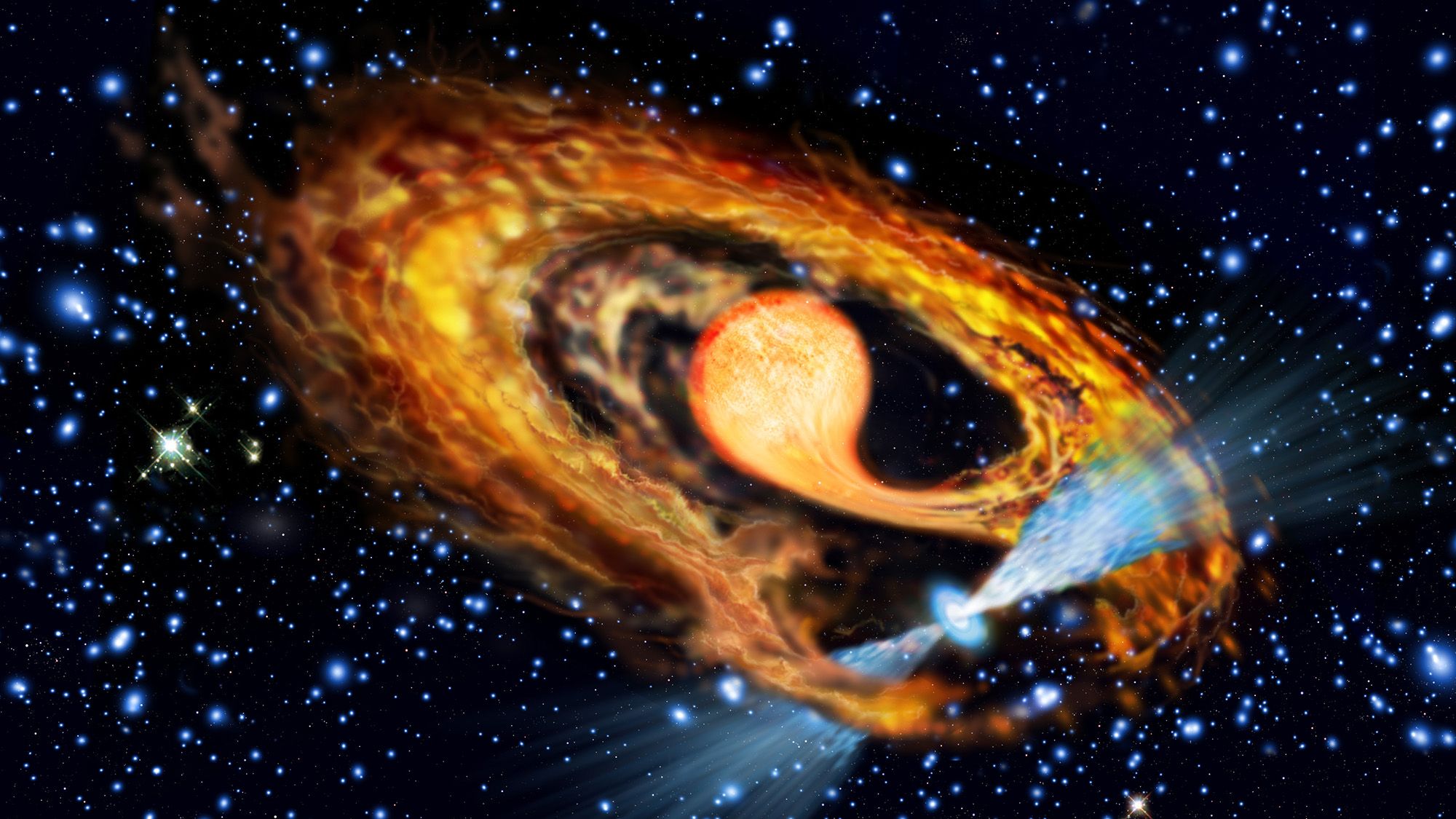
Astronomers have identified the lightest pair of neutron stars yet found, two dense stellar remnants that orbit each other roughly every 2 hours and 22 minutes and are on course to collide in about 82 million years. According to Live Science, the team timed radio pulses from one of the stars and detected three effects predicted by Albert Einstein's general theory of relativity, finding that the theory accounts for the pair's motion to within about 1%. The findings were published Sept. 15 in Physical Review Letters.
The system, catalogued as PSR J1856-0039, sits an estimated 4,200 to 6,500 light-years from Earth. It was first spotted in 2020 during a survey of the Milky Way's disk carried out with China's Five-hundred-meter Aperture Spherical Radio Telescope (FAST), described by Live Science as the largest single-dish radio telescope in the world.
Why it matters
General relativity has passed a long series of observational tests since Einstein published it, and this is another one. What makes the new result notable is the combination of a compact orbit and a relatively short observation window. Live Science reports that the team's measurements agree with Einstein's framework closely enough that the researchers found no deviation to exploit.
JinLin Han, an astronomer at the National Astronomical Observatories of the Chinese Academy of Sciences and a co-author of the study, told Live Science that the result left no room for an alternative account of gravity. "Unfortunately, we could not beat this description of gravity," he said, referring to the hope among physicists that such systems might expose gaps in the theory and point toward new physics.
The work also adds a data point at the low end of neutron star masses, a range where theory offers limited room to maneuver.
A cosmic lighthouse in a tight orbit
Neutron stars are the collapsed cores left behind when massive stars explode as supernovas. Each one squeezes more mass than the sun into a sphere about 12 miles (20 kilometers) across. A subset of them, called pulsars, rotate rapidly and send out beams of radio waves that sweep past Earth like the light of a lighthouse. Their spin is so regular that the arriving pulses serve as highly accurate clocks.
Pairs of neutron stars in which at least one member is a pulsar are uncommon. Han told Live Science that only about 30 such double neutron star systems are known, and that the relativistic effects grow strong when the two stars orbit close together.
The first of these pairs, found in 1974 and known as the Hulse-Taylor binary, gave scientists their first evidence of gravitational waves — ripples in space-time that Einstein's theory predicts. Because those waves carry energy away from an orbiting pair, the orbit should slowly contract, and the Hulse-Taylor orbit shrank at the rate the theory called for. A later system nicknamed the double pulsar, which completes an orbit every 2.45 hours, matched its predicted shrinkage to within about 0.01%. Over long enough spans, that decay drives such pairs together, producing the kind of gravitational waves that the Laser Interferometer Gravitational-Wave Observatory and the Virgo interferometer detected in 2017.
The newly studied pulsar spins about 43 times per second. The two stars are separated by roughly twice the average distance between Earth and the moon, and the orbit takes about 2.36 hours. Han described that short orbital period as the system's most striking property, telling Live Science it is the second-shortest known and should therefore produce stronger relativistic effects than either the double pulsar or the Hulse-Taylor system.
The team observed the pair with FAST 17 times between 2020 and 2025, in some cases tracking it long enough to cover an entire orbit. The researchers recorded when the pulses arrived and compared those timings with orbital models that incorporated relativistic effects, including slight shifts in arrival times depending on where the stars sat in their orbit.
Han told Live Science that the volume of FAST measurements, which he said would be difficult for other telescopes to match for accuracy, allowed the team to extract not only the basic properties of the pulsar and its orbit but also three relativistic effects.
The first is the shrinking orbit: the stars draw about 9 feet (2.7 meters) closer to each other every year as they radiate gravitational waves. The second is a slow turning of the oval orbit, at 17.6 degrees per year — roughly 150,000 times faster than the relativistic drift seen in Mercury's orbit around the sun. The third comes from the way both gravity and speed alter the passage of time, causing the pulsar's clock to run at a varying rate along its elliptical path and shifting its pulses by as much as about half a millisecond.
Weighing the stars, and checking the answer
The measurements let the researchers determine the mass of each star. Han told Live Science that the combined mass is the lowest of any known double neutron star system. The pulsar holds about 1.3 times the mass of the sun, while its companion comes in at 1.19 solar masses, making it one of the least massive neutron stars on record. Simulations indicate that supernovas cannot readily produce neutron stars much lighter than that.
Any two of the three relativistic effects are sufficient to calculate both masses. The third then acts as an independent test: if general relativity is correct, all three should yield the same values, and according to the team they do. Han told Live Science that the data require general relativity to explain them, with consistency at about the 1% level. He noted that the double pulsar test remains more precise, but it rested on 16 years of data, whereas the new result draws on about five.
The eventual merger, projected for roughly 82 million years from now, will probably leave behind a single neutron star of about 2.26 solar masses, though the researchers estimate the remnant could instead collapse into a black hole.
The team's next goal is to detect frame dragging, an effect in which a rotating mass twists the space-time around it and causes nearby orbits to wobble. Han told Live Science that the plan is to keep watching the pulsar, likely for decades, in order to measure the frame dragging produced by the neutron star's spin. Doing so would reveal the pulsar's moment of inertia, which reflects how its mass is distributed internally. That in turn would place what Han called a novel constraint on how matter behaves at the extreme densities found inside neutron star cores — one of the major unresolved questions in physics.
Watch for follow-up observations of PSR J1856-0039 in the coming years, as the team builds the long timing record needed to isolate frame dragging.