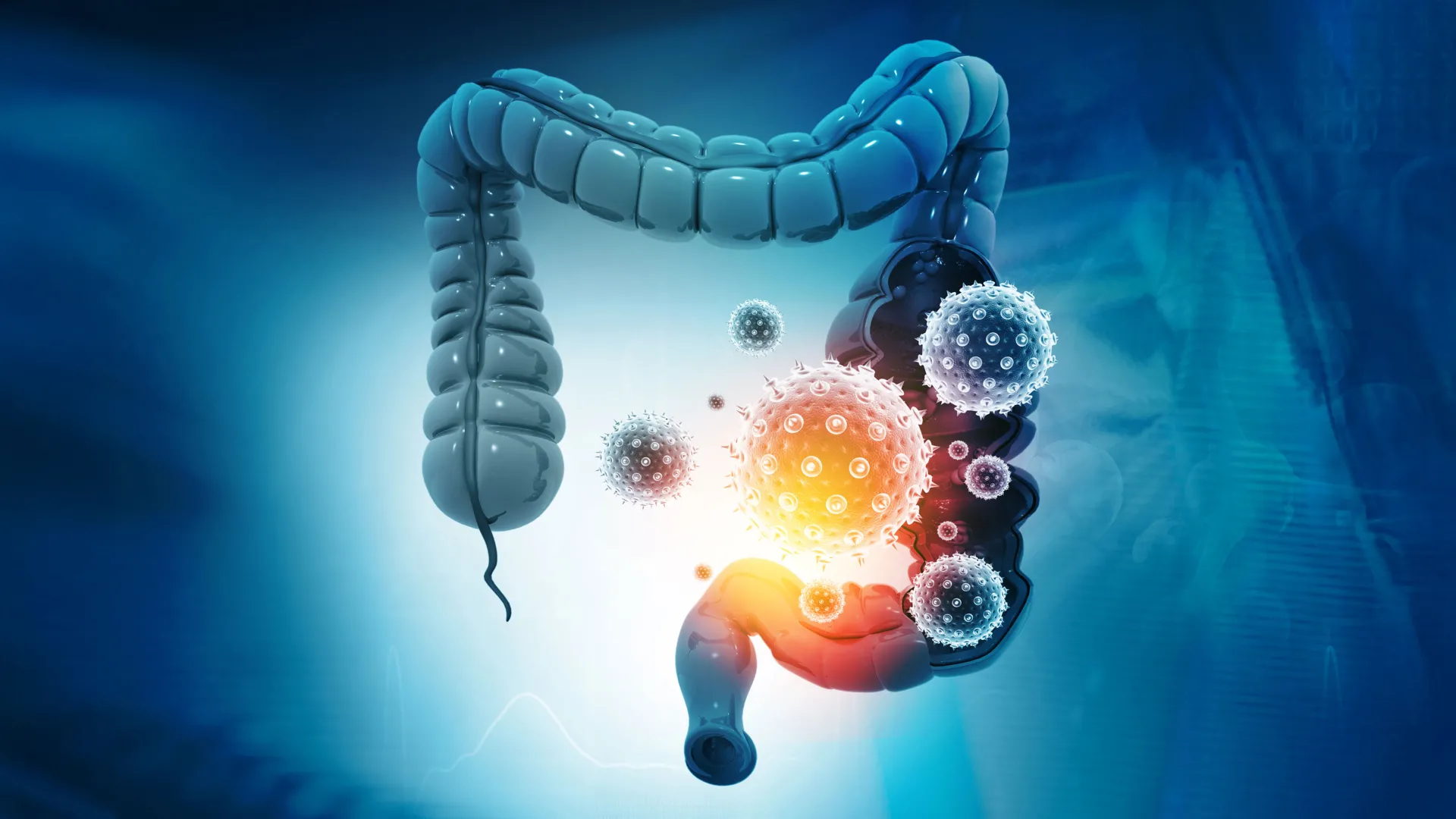
Scientists have identified the protein that a common gut bacterium's toxin latches onto before it damages the colon, according to Science Daily. The receptor, called claudin-4, was pinpointed by a team led by researchers at the Johns Hopkins Kimmel Cancer Center, its Bloomberg~Kimmel Institute for Cancer Immunotherapy and the Johns Hopkins University School of Medicine, with findings published in Nature. The same team used the discovery to build a molecular decoy that protected mice from the toxin, Science Daily reports.
Why it matters
For roughly twenty years, researchers have known that certain strains of Bacteroides fragilis release a toxin that injures the colon lining and helps tumors form. What remained unclear was the first step: how the toxin gains a foothold on intestinal cells at all. Filling in that gap gives scientists a concrete target for blocking bacterial damage tied to colorectal cancer, and possibly for other conditions the toxin is linked to.
"This is an exciting moment," senior author Cynthia Sears, a Bloomberg~Kimmel Professor of Cancer Immunotherapy and professor of medicine at Johns Hopkins, said of the long hunt for the receptor, according to Science Daily. She added that learning how bacterial toxins operate can open doors to new ways of detecting and treating related diseases, including diarrhea, colorectal cancer and bloodstream infections.
A CRISPR screen turns up an unexpected answer
B. fragilis lives in the intestines of as many as one in five healthy people, according to Science Daily. Carrying it does not mean a person will develop cancer. The danger comes from particular strains that manufacture the toxin, known as BFT, which can break down the colon's protective lining, drive inflammation and encourage tumor growth.
Earlier work had established part of the picture. A 2009 study in Nature Medicine, led by Sears and colleagues, showed the toxin could promote colon tumors, helping tie toxin-producing gut bacteria, chronic inflammation and colorectal cancer together. Later experiments revealed that BFT damages E-cadherin, a protein that binds neighboring cells and helps keep the colon's barrier intact. With that protein disrupted, the barrier weakens.
But the toxin did not seem to attach to E-cadherin directly, which suggested some other molecule was ushering it into place. Repeated efforts to find that molecule had failed.
The team approached the problem with CRISPR, the gene-editing tool that lets scientists switch off genes one by one to see what each does. Maxwell White, an M.D./Ph.D. candidate in Sears' laboratory, led a genome-wide screen of colon epithelial cells — the cells lining the colon's interior — working with Matthew Waldor's lab at Harvard Medical School. The goal was to find which genes the toxin needed in order to bind and cause damage.
One gene stood out clearly. It carries the instructions for claudin-4, a protein that helps adjacent cells form tight junctions, the seals that restrict what passes between cells and support the intestinal barrier. When the gene was disabled, BFT could no longer attach to the colon cells, and without that first contact it could not go on to attack E-cadherin.
"It took a while to get the assay working and validate the approach, but once we were able to do the screen, claudin-4 was a clear, resounding top hit," White said, according to Science Daily.
The result was not what the researchers anticipated. Sears and others had expected the toxin to engage a protein involved in cellular signaling, such as a G protein-coupled receptor, which acts like a switch for incoming signals. Claudin-4 plays a structural role instead, holding neighboring cells together rather than relaying messages.
The mechanism also appears unusual. BFT is a protease, an enzyme that cuts other proteins, and most proteases act on their targets directly. This toxin seems to need a separate receptor before it can reach E-cadherin. When the team reviewed the scientific literature, Science Daily reports, they could not find another toxin known to work the same way.
To confirm the two molecules genuinely bind, the Johns Hopkins group worked with structural biologists F. Xavier Gomis-Rüth and Ulrich Eckhard at the Molecular Biology Institute of Barcelona. Using methods that measure molecular interactions, White and the Barcelona researchers showed that BFT and claudin-4 lock together tightly in laboratory experiments, with each toxin molecule pairing with one receptor molecule — direct physical evidence of the connection.
From mechanism to a possible protective strategy
Identifying the receptor also pointed toward a way to interfere. If the toxin requires claudin-4 to gain entry to colon cells, then a stand-in molecule might draw it away from its real target. The team built such a decoy and tested it in mice, where the approach successfully shielded the animals from the toxin's harmful effects, according to Science Daily. The work received partial support from the National Institutes of Health.
Much remains between these experiments and any application in people. The decoy has so far been evaluated in animals, and the researchers describe the strategy as a possible new route to preventing bacterial damage associated with colorectal cancer rather than a proven treatment. Still, the findings give drug developers something they have lacked for two decades: a defined molecular handhold to aim at.
Watch for follow-up studies testing whether blocking claudin-4 binding holds up beyond mice, and whether the same docking mechanism appears in other toxin-producing gut bacteria.