Arctic sea ice shrank to its lowest extent ever recorded for February and March in 2025, reaching 13.75 million square kilometers and 14.14 million square kilometers respectively, according to environment coastal & offshore. A study led by researchers at The Hong Kong University of Science and Technology has now traced the event to the combined influence of two climate signals originating far from the Arctic — a weak La Niña in the tropical Pacific and an unusually warm patch of ocean in the Southern Indian Ocean.
The finding is notable because Arctic sea ice loss had been slowing on a decadal timescale since the 2010s, making an extreme winter low in 2025 stand out against that background. The publisher reports that the work was carried out by first author Cen Wang and corresponding author Prof. Hui Su, with co-authors Chengxing Zhai, Shiwei Yu, Huisi Mo, Luancheng Xu and Shuangchen Du, all of HKUST, alongside Jianqiu Zheng and Jianan Huo of the University of Science and Technology of China.
Why it matters
Most research on Arctic sea ice extremes has concentrated on the summer minimum, particularly the September records. Winter lows have drawn less scrutiny, even though winter ice conditions can set the stage for the melt season that follows and can feed back into weather patterns at mid-latitudes through the atmosphere, environment coastal & offshore reports.
The 2025 event also complicates the picture of a slowing long-term decline. The study describes the record as the product of two things layered together: the gradual loss driven by human influence and a short-term extreme produced by ocean and atmosphere interactions across the Indo-Pacific. Understanding how those two combine could improve seasonal forecasts of severe cryosphere events.
Two signals meeting over the tropical Indian Ocean
The winter of 2024/2025 brought only a weak La Niña, with modest cold anomalies in tropical Pacific sea surface temperatures. La Niña is known to influence the Aleutian Low and Arctic ice through remote atmospheric links, but on its own it looked too weak to account for how far ice extent fell. The researchers therefore widened their search and identified a pronounced warm sea surface temperature anomaly in the Southern Indian Ocean.
According to environment coastal & offshore, the two signals operate largely independently, with a correlation of just 0.09. Each is capable of producing an anticyclonic anomaly — a high-pressure circulation — over the Sea of Okhotsk–Bering Strait region, which reduces sea ice. When both appear in the same season, that anticyclone strengthens and ice loss grows larger.
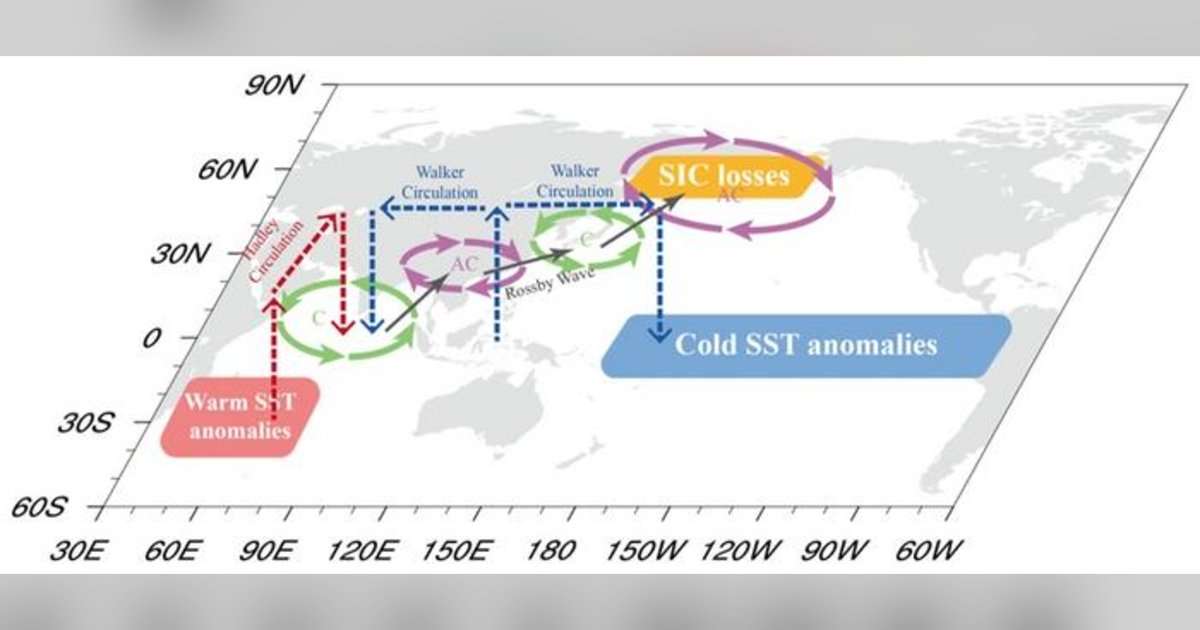
The study used satellite observations, reanalysis data and dynamical diagnostics, together with simulations from a linear baroclinic model, to work out how the connection operates. La Niña disturbs the Walker circulation, generating anomalous descending air and upper-level convergence over the tropical Indian Ocean. The Southern Indian Ocean warm anomaly alters the Hadley circulation and produces descending motion and convergence over the same region. The two forcings converge there and jointly trigger a Rossby wave train that travels northeast through southern China and Japan to the Sea of Okhotsk, where it sets up a significant anticyclonic anomaly. That circulation pattern increases the transport of heat and moisture poleward and raises downward longwave radiation, speeding local ice melt.
To isolate the warm anomaly's contribution, the team ran the linear baroclinic model with prescribed anomalous diabatic heating over the Southern Indian Ocean region. The simulations reproduced the weakened Hadley circulation, the descent over the tropical Indian Ocean and the northeast-propagating wave train seen in observations, and generated an anticyclonic anomaly over the Sea of Okhotsk — support for the mechanism derived from the observational record.
How much each signal explains
The statistics underline that neither signal tells the whole story. La Niña alone accounts for roughly 20 percent of year-to-year variability in sea ice extent, while the Southern Indian Ocean warm anomaly accounts for about 13 percent. A combined Niño3–SIO index correlates with sea ice extent at 0.60, corresponding to about 36 percent of the variance, indicating that the Indian Ocean signal adds explanatory power beyond ENSO by itself.
Among the four years on record in which La Niña and the Southern Indian Ocean warm anomaly occurred together, three — 1981, 2011 and 2025 — rank among the lowest sea ice extent years on interannual timescales, environment coastal & offshore reports.
The authors are careful about the limits of the finding. ENSO and the Indian Ocean signal explain only part of extreme events, and not every La Niña or warm-anomaly year produces severe ice loss. Decadal variability and ice changes outside the Pacific sector, including in the Barents–Kara Seas, may also play a role and deserve further study, according to the report.
The paper describes what it calls a cross-basin atmospheric bridge: La Niña's east-west disturbance of the Walker circulation and the warm anomaly's north-south alteration of the Hadley circulation both feed into the tropical Indian Ocean, where their influence converges to excite a northeast-propagating Rossby wave and establish an equivalent barotropic anticyclonic anomaly over the Sea of Okhotsk. The authors argue this shows the importance of combined Indo-Pacific forcing in producing extreme Arctic ice loss on top of the long-term decline, and say it offers new leads for seasonal prediction of such events.
The research was supported by the Hong Kong Jockey Club Charities Trust, the Innovation and Technology Commission, the Innovation and Technology Fund, the Research Grants Council, the NSFC/RGC Collaborative Research Scheme and the State Key Laboratory of Climate Resilience for Coastal Cities.
What to watch next is whether forecasters can turn the combined index into an operational tool — and whether the next season in which La Niña and a warm Southern Indian Ocean coincide again produces another outlier in the Arctic ice record.





