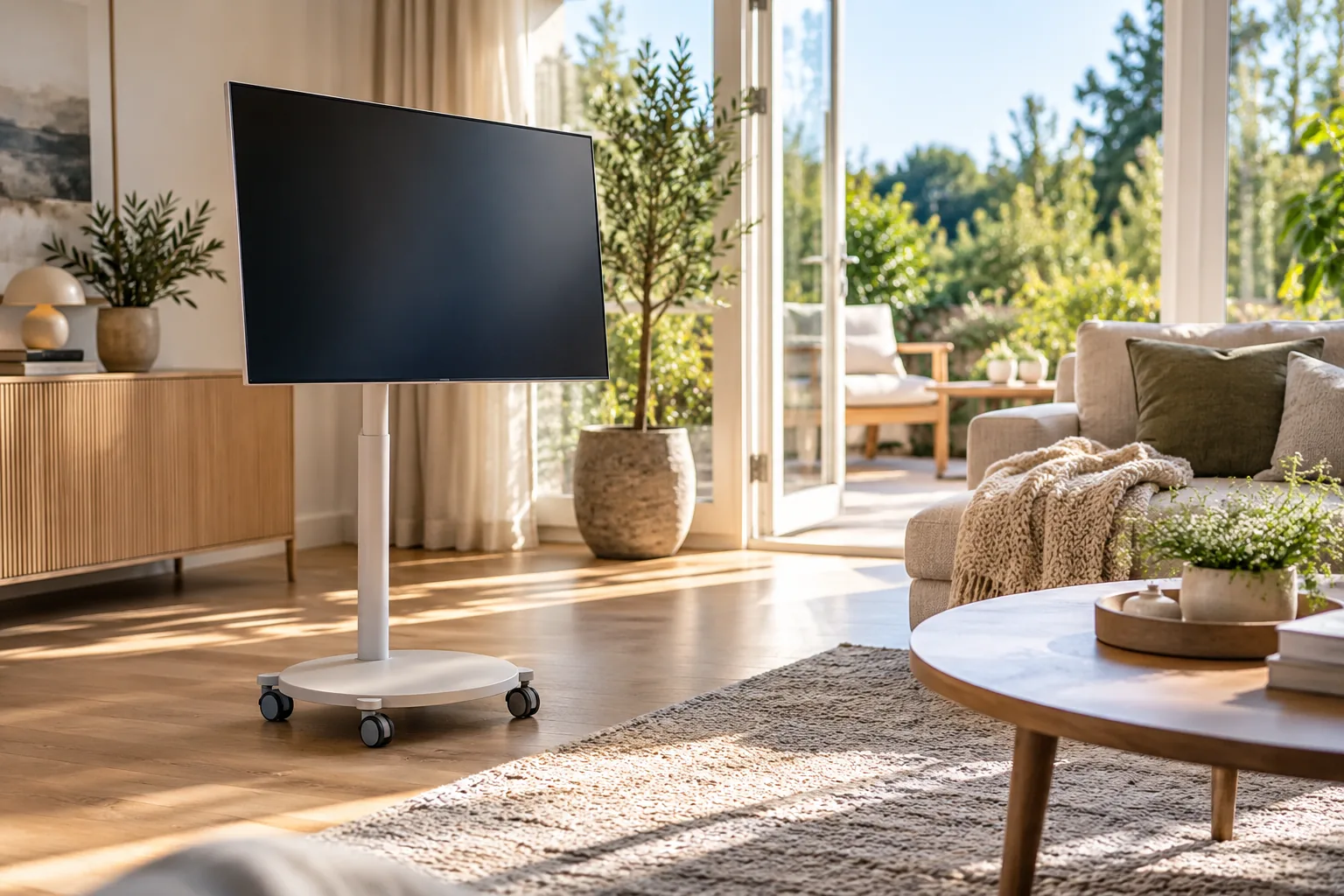
Swedish comparison site HurBra.se has published its roundup of portable televisions for 2026, naming Samsung's The Movingstyle as its top pick ahead of LG's StanbyME 2. The review, published on 26 October, compares models from Samsung, LG and Thomson and weighs specifications, features, Swedish pricing and previously published independent tests. HurBra.se states that it did not carry out laboratory testing of the products itself.
The site's central argument is that a screen you can roll from the living room to the kitchen, lift off its stand and carry onto the patio has become a genuine alternative for people who do not want their viewing tied to a fixed set. Its verdict is that Samsung's model is the strongest all-round choice, with LG's offering a close second for buyers who expect to detach the display often.
Why it matters
Portable televisions sit in an awkward spot between two established product categories, and HurBra.se's review makes that tension explicit. A rolling screen costs roughly what a much larger conventional TV costs, and in some respects it performs worse. The site is direct about the trade-off: at the same price, a buyer could get a considerably bigger ordinary television with better picture quality.
What the format offers instead is flexibility. The review frames the category as being for people who want to watch films and series without being anchored to one room, and it judges each model on how well it serves that goal rather than on raw picture benchmarks alone.
The roundup also flags an issue that affects anyone shopping in Sweden. Not every model in the comparison is straightforward to buy there. HurBra.se notes that Thomson's Go Plus and Go TV have limited availability, and that LG's StanbyME 2 Max has no confirmed Swedish sales launch yet. Those sets are described as interesting options but not as obvious purchases in the way the Samsung and the standard StanbyME 2 are.
Samsung's lead rests on software and a faster panel
HurBra.se's pick is built around a 27-inch QHD screen with a resolution of 2,560 by 1,440 pixels. The display sits on a wheeled floor stand but can be removed and used on its own, and an integrated handle makes it easier to carry. At around 5.2 kilograms once detached from the stand, the site notes, it is movable but not as comfortable to carry as a tablet.
The review's main praise concerns purpose. HurBra.se argues that the Movingstyle is designed first and foremost for television entertainment, which shows in its interface and in the ability to run streaming services without treating the device as an oversized tablet. The 120 Hz refresh rate is also counted as an advantage over competitors with 60 Hz panels, though the site cautions that a faster panel does not mean ordinary broadcast material is displayed at 120 frames per second.
The screen is sharper than Full HD but falls short of 4K, which HurBra.se calls a reasonable compromise at this size. It also points to a comparative test at PC för Alla, where the Samsung received four out of five and was named the best rolling screen among three products tested.
The drawbacks are stated plainly. The price is high, the quoted battery life tops out at three hours — enough for a film or a few episodes, the site says, but not a full evening — and the LCD panel cannot match the best OLED sets for black levels and contrast.
LG's challenger wins on battery and portability
LG's StanbyME 2 uses the same 27-inch QHD resolution but a 60 Hz panel, with a claimed battery life of up to four hours, one hour more than Samsung's figure. HurBra.se treats manufacturer battery claims as approximate maximums rather than guarantees, noting that brightness, volume, connectivity and the content being shown all affect runtime.
The LG can stand on its wheeled base, rest on a piece of furniture or be used free-standing, and a dedicated strap allows it to be carried. HurBra.se says this makes it usable in more situations than a set that always has to stand on the floor, whether that means moving it from the sofa to the kitchen table or using it as a secondary screen in a study.
The detachable display weighs about 4.3 kilograms, close to a kilogram less than Samsung's. Sharpness is judged suitable for films, series and everyday use at this size, but contrast again falls short of a modern OLED television.
HurBra.se also cites a longer test by TechRadar, which highlighted the StanbyME 2's flexibility while pointing to limited contrast and a high price. That test further noted that the set could draw a noticeable amount of battery even in standby, a detail worth knowing for anyone who plans to use it only occasionally and expects the charge to hold between sessions.
Pricing for the LG is given as roughly 11,400 to 15,700 kronor, against about 12,000 to 15,000 kronor for the Samsung.
What to watch
HurBra.se advises buyers to separate documented test results from the battery life and picture performance that manufacturers advertise, and to check Swedish availability before settling on a model. The next signal to watch is whether LG confirms a Swedish launch for the StanbyME 2 Max, which would widen the field beyond the two sets the site currently treats as the obvious choices.