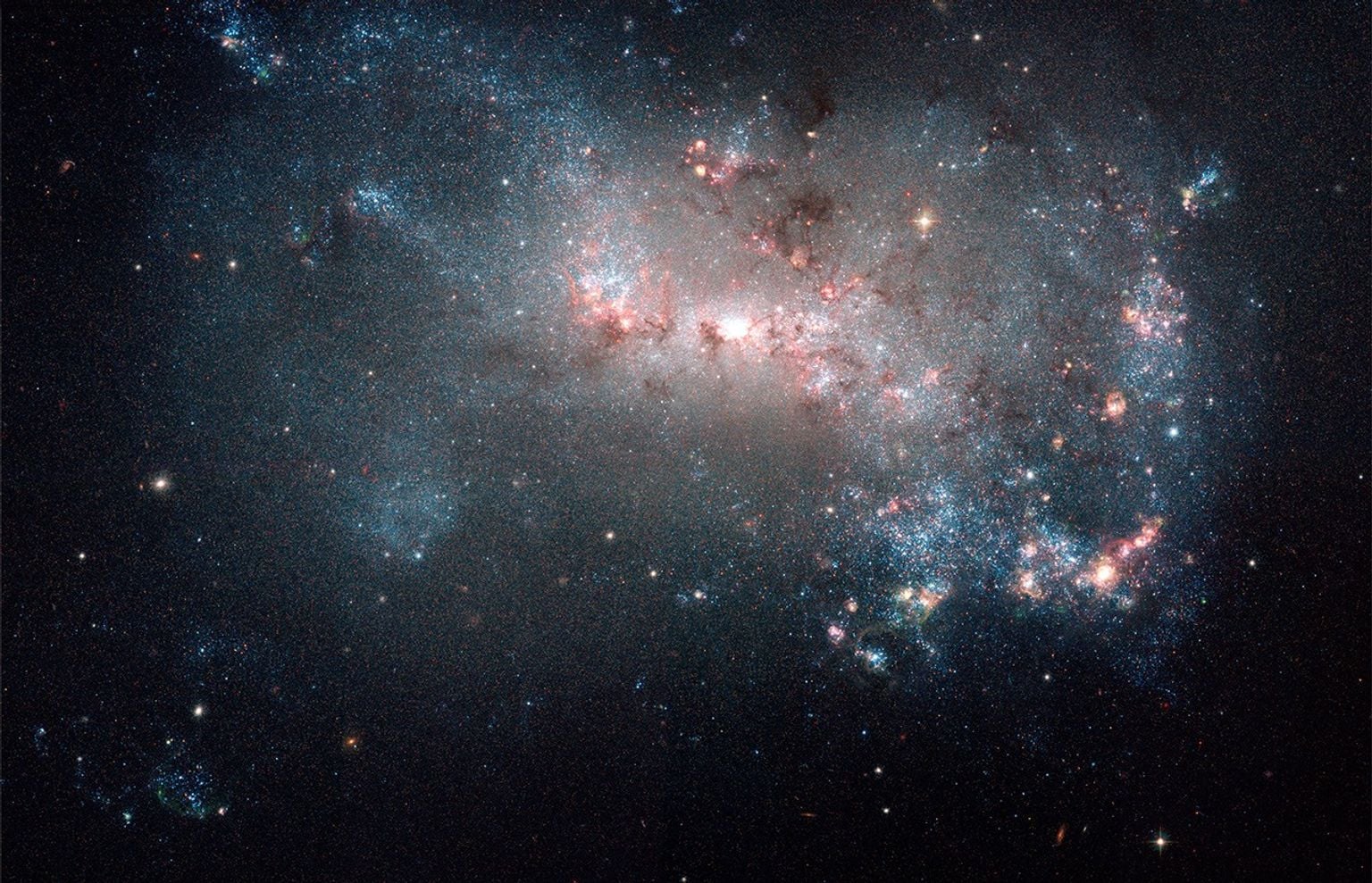
A paper published in The Astrophysical Journal reports that a survey of 37 nearby dwarf galaxies found far less oxygen inside them than researchers expected, according to Universe Today. The work drew on observations from the Hubble Space Telescope, NASA's retired Spitzer Space Telescope, the ground-based Very Large Array and the Australian Telescope Compact Array, NASA said. The team found that low-mass galaxies hold on to only a modest share of the oxygen their stars create.
Grace Telford, the paper's second author and an assistant professor in the University of Utah's Department of Physics and Astronomy, told Universe Today that the study is the first to measure both how much oxygen stars in low-mass galaxies have produced and how much of it has escaped over the galaxies' lifetimes. Dwarf galaxies, which range from a few thousand to hundreds of millions of stars, retain only a small fraction of that output, according to NASA.
Why it matters
Oxygen is the third most abundant element in the cosmos, and its production is well understood, which makes it a dependable marker for tracking how heavier elements spread through galaxies. Those heavier elements — iron, carbon, nickel, magnesium and sulfur among them — are the raw material from which rocky, potentially habitable planets form. If astronomers misjudge how much oxygen a galaxy keeps, their picture of where planet-building material ends up is incomplete too.
The findings also bear on models of how galaxies form and evolve. Telford told Universe Today that low-mass galaxies appear to lose more oxygen than current simulations predict, which suggests the physics of how massive stars affect their host galaxies is not yet fully captured.
Where the oxygen goes
Most of the oxygen in these galaxies comes from core-collapse supernovae, the explosive ends of massive stars, Telford said. A small additional share arises from other supernovae involving the remnants of lower-mass stars that become unstable or merge.
According to Telford, roughly 15 percent of the oxygen produced by stars in these low-mass galaxies is still inside them today. Most of that remainder sits in the galaxies' gas, with smaller amounts locked in stars and dust. The rest has been pushed out over time by the energetic radiation of massive stars and by their supernova deaths, which drive oxygen-rich gas beyond the galaxies' boundaries.
That missing material is thought to reside largely in the gaseous halos surrounding the galaxies, known as the circumgalactic medium, and some has likely traveled further still into intergalactic space. The idea, per Telford, is that energy from massive stars and supernovae is what propelled most of the oxygen outward.
The measurements come from the Galaxies Losing Oxygen via Winds project, or GLOW, which is funded jointly by NASA and the National Science Foundation. Universe Today describes GLOW as a large-scale effort to understand how gas and heavy elements move between low-mass galaxies, their surrounding halos and the space between galaxies. The project combines new and archival observations of low-mass galaxies taken from both the ground and space.
A contrast with the Milky Way
Similar accounting of oxygen and other heavy elements lost from galaxies has been done for massive systems such as our own, Telford said. Low-mass galaxies, however, have weaker gravity and are expected to shed such material more readily — and the new paper shows that they do.
The difference shows up in the ratios. Telford said the Milky Way has about one oxygen atom for every 2,000 hydrogen atoms, while low-mass galaxies in the GLOW sample run closer to one oxygen atom per 10,000 to 20,000 hydrogen atoms.
Universe Today's report was written by science journalist Bruce Dorminey, a former Forbes senior science contributor who has also written for Astronomy Magazine, Scientific American, Science, Nature News and National Geographic, among other outlets.
The paper's results rest on a sample of 37 galaxies, so the next step is likely to be wider surveys that test whether the same pattern holds across other low-mass systems. Watch for further GLOW results and for updates to galaxy formation simulations as theorists try to account for the shortfall.





