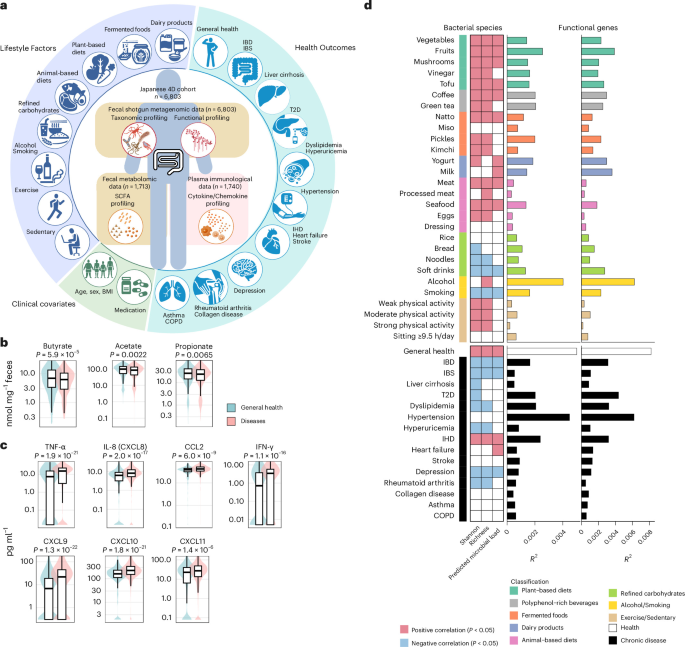
A study published in Nature on 5 November has identified two opposing gut microbiome pathways that appear to connect modifiable lifestyle habits to overall health and to 15 chronic diseases. Researchers analysed fecal shotgun metagenomes from 6,803 adults enrolled in the Japanese 4D (Disease, Drug, Diet and Daily Life) cohort, with a mean age of 60.9 years and 58.2% male participants. According to Nature, the work offers one of the first integrated frameworks linking multiple lifestyle factors, the microbiome and a broad set of physician-confirmed health outcomes in a single large population.
The team examined 28 modifiable lifestyle factors, including diet, alcohol intake, smoking and physical activity, alongside general health status and 15 chronic diseases, each with at least 100 cases. Both health and disease diagnoses were based on physician-confirmed records rather than self-reporting, and analyses were adjusted for age, sex, body mass index and other predefined confounders. Participants classed as in good general health had no comorbidities, chronic disease history, surgery, medication use or hepatitis B, hepatitis C or HIV infection.
Why it matters
The World Health Organization estimates that more than two-thirds of global deaths stem from chronic diseases, and modifiable lifestyle factors are known to play a central role in their development. What has been less clear is how the gut microbiome fits into that relationship. Nature reports that earlier research tended to look at lifestyle factors and diseases separately, leaving the microbiome's role as an intermediate factor poorly characterised.
This study used mediation analysis to split associations into indirect components passing through the microbiome, a statistical approach that requires large cohorts to be reliable. By applying it across many lifestyle factors and diseases at once, the authors say they have produced a scalable framework for microbiome-based assessment that could eventually help guide lifestyle interventions for prevention.
Two pathways pulling in opposite directions
The central finding is a pair of microbiome-mediated axes with contrasting profiles. One, associated with health, was enriched in microbial metabolism of dietary components and was linked to intake of plant-based foods, soy and dairy. The other, associated with disease, carried a higher load of oral-derived bacteria and pathobionts and was linked to refined carbohydrates and sedentary behaviour.
Alcohol stood apart: it was associated with mediation patterns pointing in both the health and disease directions, involving microbial utilisation of host glycans. The researchers also tested microorganisms used as starter cultures in fermented foods and found they did not show statistically significant mediation of the observed health effects.
To check the biology behind these patterns, the team drew on fecal short-chain fatty acids and plasma cytokines from more than 1,700 individuals. Nature reports that this supported the two axes, revealing a butyrate-associated anti-inflammatory host profile on the health side and a pro-inflammatory profile on the disease side.
Prediction scores tested across five countries
The researchers condensed the mediation patterns into microbiome-based prediction scores, which they call MADE scores. These scores distinguished individual diseases when tested in 13 independent external cohorts from the United States, China, Sweden, Russia and Australia.
The authors describe the gut microbiome as a key mediator linking lifestyle to health and disease. The study's limitations are implicit in its design: the cohort is Japanese and older on average, so the findings will need confirmation in other populations, and the cross-sectional nature of the data means the pathways are statistical mediations rather than proven causal chains.
What to watch next is whether the MADE scoring approach is validated prospectively in other cohorts and adapted into clinical or public health tools. For now, the study offers a structured way to think about how everyday choices may work through the gut to shape long-term disease risk.





