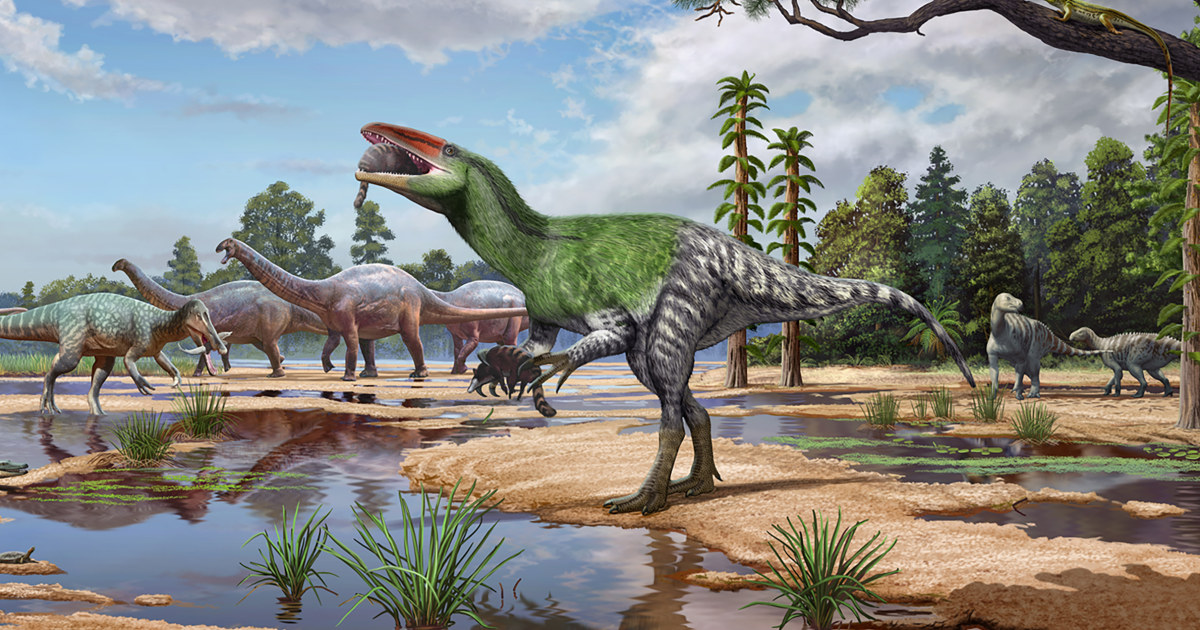
A fragmented dinosaur skull that sat unnoticed in a museum drawer for roughly a century has been identified as a new species, according to research reported by NBC News. The fossil, collected about 100 years ago and acquired by the Natural History Museum in London in 1924, belongs to a tiger-sized predator that lived roughly 120 million years ago on what is now the Isle of Wight, off England's southern coast.
Researchers named the species Invictibellatrix amberina. It is an early member of a group of Cretaceous meat-eaters called megaraptorans, and it is the first of that lineage ever found in Europe. The study was published in the journal Royal Society Open Science, with Cassius Morrison, a postdoctoral researcher at the University of Leeds, as lead author.
Why it matters
Megaraptorans are among the more poorly understood groups of predatory dinosaurs, and the new fossil fills two gaps at once. According to NBC News, it adds detail to what scientists know about the skull anatomy of early megaraptorans, and its European origin supports a long-standing idea about how the group spread across the planet.
Until now, that dispersal hypothesis had lacked fossil evidence from Europe. One leading scenario holds that megaraptorans arose in Asia, moved through Europe into Africa, and then reached South America, where they survived until an asteroid strike wiped out the dinosaurs 66 million years ago. The Isle of Wight specimen is the first European piece of that puzzle.
"This hypothesis was lacking fossil evidence because no megaraptorans had been known from Europe until now," Charlie Scherer, a doctoral student at University College London and a co-author of the study, said, per NBC News. Scherer added that the findings help uncover the evolution of one of the most mysterious theropod groups.
A lightly built hunter with enormous claws
Megaraptorans belong to the theropods, the broad group that includes every meat-eating dinosaur. Morrison described them to NBC News as unusual among theropods: their heads were comparatively small and slender, but their arms were long and powerful, tipped with very large hand claws, and their skeletons were built lightly.
Those traits, in Morrison's account, point to agile predators that could run down prey and then use their arms and claws to seize and disembowel it.
Invictibellatrix ranks among the smallest known megaraptorans. Drawing on fossils of close relatives, the researchers estimated it measured about 16 feet long and weighed roughly as much as a large tiger. Its body may have been covered in filament-like feathers, they said.
The largest megaraptoran on record, a dinosaur called Maip, reached about 33 feet in length and lived in Patagonia near the end of the age of dinosaurs — around 50 million years after Invictibellatrix.
Smaller megaraptorans such as Invictibellatrix likely pursued modest prey: mammals, smaller reptiles and juvenile dinosaurs. Bigger members of the group may have gone after larger plant-eaters such as duckbilled hadrosaurs and long-necked sauropods, though probably not the very largest of them.
Their hunting style stood in contrast to that of Tyrannosaurus rex, which killed with a heavy, powerfully built skull, huge teeth and a formidable bite, while carrying arms too small to be of much use in bringing down prey. Invictibellatrix worked in the opposite way, relying on speed and its clawed forelimbs.
It was not the top predator on the Isle of Wight, where larger theropods also lived alongside a range of herbivorous dinosaurs. NBC News reports that it may have filled an ecological role comparable to that of a hyena today.
A century in a drawer
The fossil itself is a fragmented braincase, and its path to recognition was slow. It was found about a hundred years ago and entered the Natural History Museum's collection in 1924.
"It was left in one of the collection's drawers ever since, and no one noticed it until a couple of years ago," Scherer said, according to NBC News.
The question of where megaraptorans sit on the theropod family tree remains unsettled among paleontologists. Despite the differences in build and hunting method, one hypothesis places them as close relatives of tyrannosaurs — the group containing Tyrannosaurus and other dinosaurs that dominated North America and Asia later in the Cretaceous.
Morrison also offered a thought experiment about how the two predators would compare from a human's point of view. He told NBC News that a smaller theropod like Invictibellatrix would probably pose a greater danger to a person than T. rex would, because a human would likely be too small for so massive a predator to regard as a worthwhile meal given the energy required to catch one. A person would instead be about a third to a quarter of Invictibellatrix's weight — a substantial meal rather than a snack — and the dinosaur had the agility and maneuverability to chase a human down.
The identification of Invictibellatrix rests on a single braincase, so further fossil material from the Isle of Wight and elsewhere in Europe will be needed to test where the species and its relatives belong on the theropod family tree.





