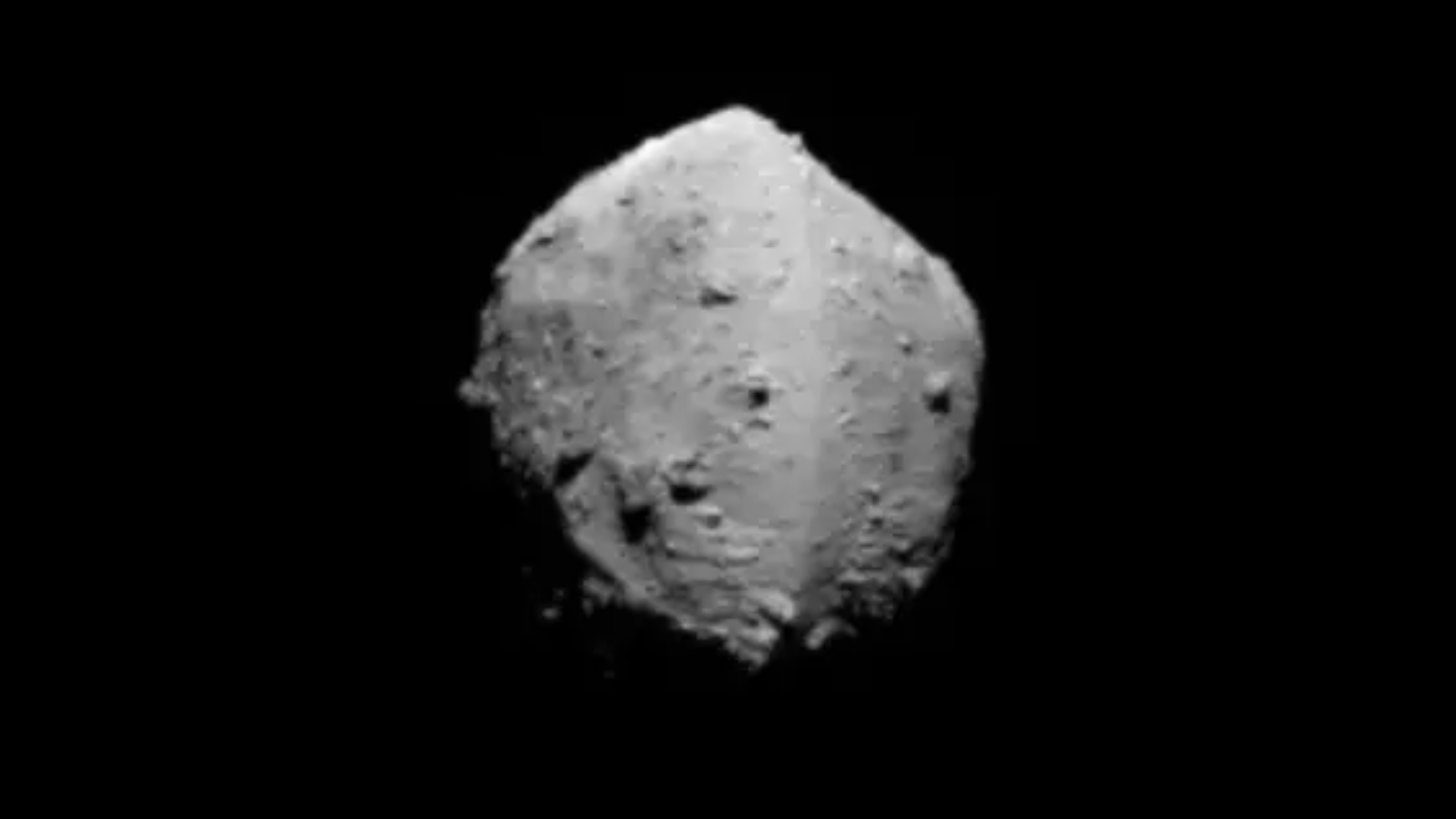
The European Space Agency's Hera spacecraft has delivered its first close-up view of the Didymos binary asteroid system, the same pair of space rocks that NASA deliberately struck four years ago. ESA released the image on Thursday, Nov. 5, 2026, according to Space, which featured it as its photo of the day for Nov. 6.
The picture shows Didymos in sharp detail, with only a small edge of its smaller companion, Dimorphos, visible just below and slightly left of the main body. Hera's principal investigator, Patrick Michel, said the view captures the side of Didymos that NASA's DART camera never saw before it slammed into the moonlet, describing the sensation as looking at an entirely new world, Space reported.
Why it matters
The image marks the start of Hera's main job: inspecting the aftermath of the first real-world test of asteroid deflection. NASA's DART spacecraft hit Dimorphos on Sept. 26, 2022, to see whether a kinetic impact could nudge an asteroid off a course toward Earth. The experiment worked. Before the collision, Dimorphos circled Didymos once roughly every 11 hours and 55 minutes; afterward, that lap was about 33 minutes shorter, according to Space.
That shift came about because the moonlet's orbital speed dropped by roughly 2.7 millimeters per second compared with its pre-impact pace. The change sounds tiny, but in a genuine threat scenario even a small alteration could push a dangerous asteroid away from Earth — provided scientists detect the object far enough ahead of time.
Hera's observations are meant to fill in what DART could not measure. The impactor was destroyed on contact, so the crater it carved and the debris it scattered have gone unexamined up close until now.
What the first image already shows
Didymos, a rocky body about 2,560 feet (780 meters) wide, still carries the central ridge along its equator that it had before the impact. But scientists are already spotting fresh features, including numerous boulders, craters, and new patterns of grooves and ridges, Space reported.
Michael Kueppers, ESA's Hera mission scientist, said much of the material blasted off Dimorphos was expected to have crossed the roughly 1 kilometer (0.62 miles) of space separating the two bodies and landed on Didymos. Some of the newly seen surface features may trace back to that shower of debris, he said, adding that the team has substantial work ahead to determine which ones do.
Dimorphos itself is about 530 feet (160 meters) across. Hera's image offers only a glimpse of it so far, but the mission is expected to return far more of both bodies as it continues its survey.
A mission built on a previous mission's success
Hera was designed from the outset as DART's follow-up. Where the NASA probe provided a single, brief data point at the moment of impact, the ESA craft is intended to give researchers a sustained look at the system, mapping changes on both asteroids and refining estimates of how much material was moved and where it went. That information matters for turning a one-off demonstration into a technique that could be relied on in an emergency.
The mission also carries value beyond planetary defense. Binary asteroid systems are common, and close study of Didymos and Dimorphos — their shapes, surfaces, and the way they interact gravitationally — adds to the broader understanding of how such pairs form and evolve.
For now, the team is working through the first image and preparing to systematically chart the alterations the impact left behind. Kueppers said the researchers are eager to see much more of both bodies as the mapping effort proceeds.
Watch for Hera's next rounds of imagery, which should bring Dimorphos fully into view and allow scientists to compare the moonlet's post-impact surface directly with the shape DART recorded moments before it struck.





