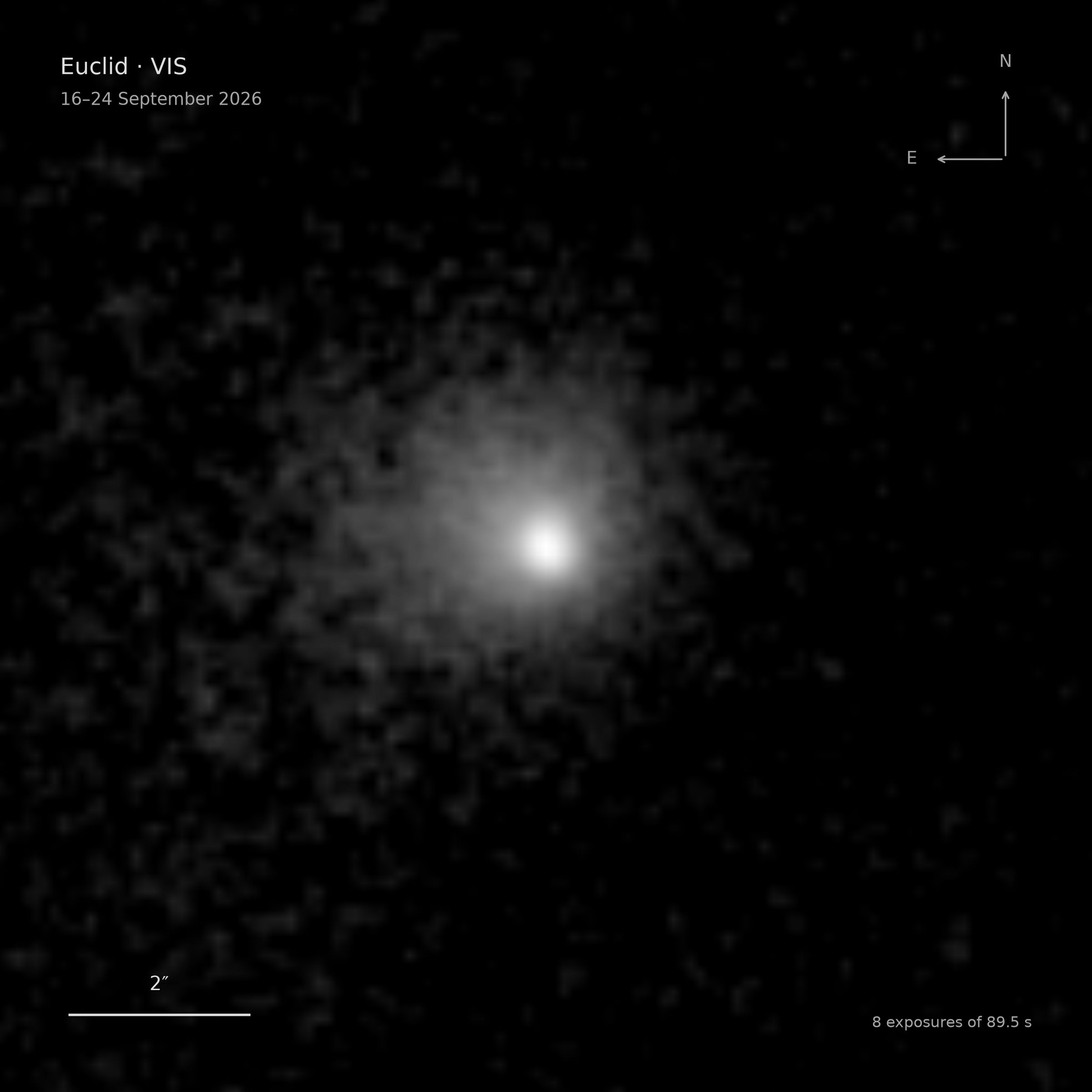
The European Space Agency's Euclid mission has discovered a comet that had never been seen before, according to Media INAF. The object, designated C/2026 S1 (Euclid), follows a long-period orbit that takes more than 300,000 years to circle the Sun and is currently about 1.3 billion kilometres from Earth.
Euclid, which is surveying the sky to catalogue billions of galaxies in support of its study of dark matter and dark energy, recorded the body in sixteen images taken between 16 and 24 September 2026. The observations were made while the telescope was examining the Euclid Deep Field North, one of three small patches of sky the mission is studying in extreme detail alongside its wider but shallower sweep of roughly a third of the celestial sphere.
Why it matters
The find is unusual because Euclid was not built to hunt comets. The telescope deliberately avoids the most crowded region of the Solar System to keep dust glare out of its deep images, and it generally does not return to the same patch of sky, which makes it hard to catch an object moving from one field to the next. Media INAF reports that the mission is expected to turn up very few comets, so the discovery stands out for a spacecraft with a completely different scientific brief.
It also has practical value. The speed with which the comet was identified and confirmed shows that Euclid can detect new comets while they are still relatively far from the Sun, a capability that could prove useful for ESA's Comet Interceptor mission, due to launch at the end of this decade to meet a comet that has not yet been found.
A streak in the data
The signal was first noticed by Mikko Pöntinen, a doctoral student at the University of Helsinki and a member of the Euclid collaboration's group for Solar System objects. According to Media INAF, his software flagged a streak spread across several images, the signature of something moving quickly during the exposure. By predicting where the object should be, he located it in five separate sets of images in total. Closer inspection showed a fuzzy cloud around it, a sign of an active body releasing dust and gas.
A check against catalogues of known comets and asteroids turned up nothing, so the finding was passed to the Minor Planet Center, the organisation tasked by the International Astronomical Union with collecting data on small Solar System bodies. The centre issued an alert to observatories around the world, and telescopes in Switzerland, Austria, Hungary, Romania, Canada, the United States and Hawai'i observed the object between late September and early October. That campaign confirmed it as a comet, announced in a circular on 8 October.
In the Euclid images, the comet appears as a streak because of its motion during a long exposure of about nine minutes, and it is wrapped in a halo of gas and dust known as a coma. A second view released with the discovery combines eight shorter exposures of roughly a minute and a half each, with contaminated regions masked out.
An orbit out of step with the planets
The comet is currently travelling between the orbits of Jupiter and Saturn. Rather than moving in the plane that holds the planets of the Solar System, it follows a highly elongated ellipse around the Sun that lies perpendicular to that plane. It has a magnitude of 20.7 and cannot be seen with the naked eye; Media INAF issued a correction on this figure after an earlier version gave a different value.
Euclid has captured known comets before, but this is the first time it has found one that had never been observed. The mission does pay attention to Solar System objects, since it needs to identify everything in its images and strip out light from sources that are not cosmological. Still, new discoveries in our own cosmic neighbourhood are rare for the telescope, as Media INAF notes.
Bruno Altieri, a Euclid archive scientist at ESA and a member of the team behind the discovery, said in remarks reported by Media INAF that few comet discoveries were anticipated from the mission. He described it as a fortunate coincidence that the comet's path and Euclid's scanning schedule on those days lined up to capture the object in multiple images.
Valeria Pettorino, Euclid project scientist at ESA, said the particular comet is not a suitable target for Comet Interceptor, according to Media INAF. She added that the discovery and alert process nonetheless serves as a rehearsal for future coordination between the two mission teams, and that the scientists are pleased to have found a previously unknown comet for the Solar System research community to study further.
Watch for follow-up observations of C/2026 S1 (Euclid) as it continues along its orbit, and for the first test of Euclid's discovery-and-alert pipeline in support of Comet Interceptor planning.