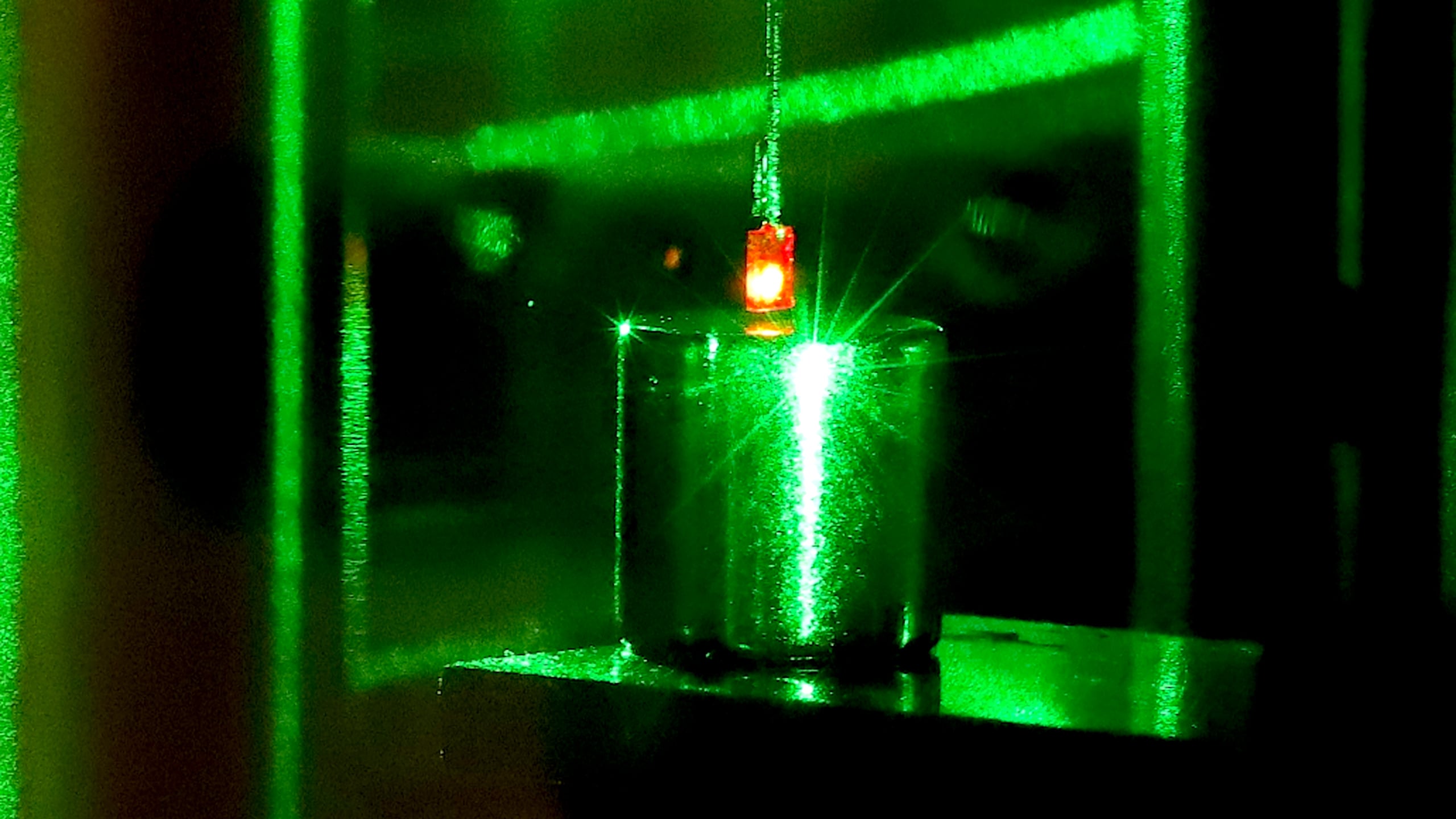
Researchers at the Okinawa Institute of Science and Technology (OIST) in Japan have moved a centimeter-sized object using the spin of electrons, a first for an experiment at that scale. The team's study, published in Science Advances, describes how a graphite plate suspended by magnets was pushed roughly 100 nanometers — about one-thousandth the width of a human hair — when the spins of electrons inside a small diamond attached to it were manipulated with laser light. ScienceAlert reported the findings.
The movement itself was ordinary, classical motion. What matters is the cause: a quantum property of electrons, their spin, which behaves like a tiny built-in compass needle in each particle. Until now, such spin forces had only been strong enough to shift individual atoms. The OIST object weighed about 128 milligrams, comparable to a few grains of rice, and the researchers say it is eight to nine orders of magnitude more massive than the objects used in the best existing spin-mechanical experiments.
Why it matters
Physics has two sets of rules that do not easily fit together. Quantum mechanics describes the very small, where particles can exist in combinations of states at once. General relativity describes gravity and the very large. Experiments that test whether quantum rules still hold for bigger objects have been attempted for years, according to ScienceAlert, but none had succeeded at this scale.
The OIST apparatus is large enough for gravity to act on it strongly, which makes it a candidate for probing how the two frameworks meet. Theoretical physicist Jason Twamley, part of the team, said many efforts had tried to test quantum mechanics beyond a few tens of nanometers without success, and that the group has now seen a classical mechanical response to a quantum force on an object far heavier than previous work.
How the experiment worked
The setup relied on several design choices working together. A graphite plate sat above a checkerboard arrangement of magnets, which levitated it through diamagnetism — the same principle that can lift maglev trains off their tracks. Suspended beneath the plate was a diamond measuring 3 millimeters across, containing atomic defects called nitrogen vacancy (NV) centers.
Those defects give the diamond electrons whose spins can be controlled. The team used laser light to manipulate the spins, then applied another magnet to convert that spin behavior into physical movement of the whole assembly. The entire structure, plate and diamond together, weighed around 128 milligrams.
Physicist Daehee Kim noted that NV diamonds are well understood and simple to control, and that NV centers hold quantum superposition at room temperature for longer than many other systems. Those long coherence times, Kim said, make the material appealing for future work aimed at putting the motion of a larger object into a quantum state.
Working from large to small
Much of quantum research starts with the smallest possible systems and builds upward. The OIST group took the reverse route. Physicist Anshuman Nayak said the team is in the opposite camp, going from large to small, and compared the levitation method to the way maglev trains are lifted. The same effect, he said, can hold centimeter-wide objects carrying diamonds aloft, in a setting where gravity's pull is strong but quantum effects had not previously been seen.
That inversion is central to the result. The plate is not planet-sized, but in quantum terms it is enormous, and it sits in a regime where gravity cannot be ignored. The researchers describe the outcome as a large classical response triggered by a small quantum effect. Twamley said the question is no longer whether such technology is possible, but how experimental conditions can be refined to reach quantum superposition in the regime governed by Einstein's general relativity.
What to watch
The team's next target is scale. Twamley said the work pushes the boundary from nanometers to centimeters, and that one more order of magnitude could allow observation of a Schrödinger's cat-like state in a real object — a system occupying two states at once. Whether that step arrives will depend on tightening control over the experiment's conditions, including the coherence of the spins and the stability of the levitating platform.





