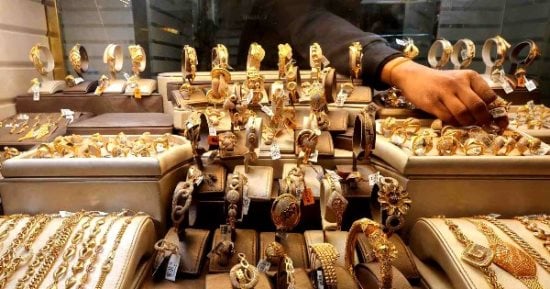
Gold prices in Egypt showed little movement on Thursday, 22 October 2026, with the most widely traded 21-karat grade hovering around 6,300 Egyptian pounds per gram, according to a market roundup published by Youm7. The same report put the Egyptian pound at more than 54 to the dollar and placed international bullion trading near $4,130 an ounce amid limited activity on global markets.
The figures reflect a market that has settled into a narrow range after a volatile stretch, with local pricing shaped as much by the currency as by the metal itself. Youm7's update was one of several Egyptian outlets carrying daily gold quotes on Thursday, alongside reports from Al Mal, Mubasher and Masrawy.
Why it matters
Gold is a savings vehicle as much as a luxury purchase in Egypt, and the 21-karat price is the reference point most households watch. When the pound is weak, local gold prices can climb even if the international ounce price is flat, because a weaker currency raises the Egyptian-pound cost of a dollar-denominated asset.
That dynamic is visible in Thursday's numbers. Bullion near $4,130 an ounce is well below the peaks that investment banks had once projected for this year, yet the local 21-karat quote remains close to 6,300 pounds. The gap is explained largely by the exchange rate, which the Youm7 report placed above 54 pounds per dollar.
Investment banks have cut their 2026 targets
The international picture has shifted over the course of the year. According to the Youm7 report, several major investment banks have lowered their gold forecasts for 2026. CIBC reduced its fourth-quarter target from $6,500 to $4,500 an ounce. JPMorgan Chase cut its own projection to $4,500, UBS moved to $4,600, and Goldman Sachs set its target at $4,650.
Those revisions put the banks' expectations much closer to where the metal is actually trading. Thursday's level of roughly $4,130 an ounce sits below even the lowest of the revised targets, suggesting the banks now see modest upside from current prices rather than the sharp rally once anticipated.
The cuts also illustrate how quickly forecasters have adjusted to a year in which gold did not deliver the breakout that some had expected. The original targets above $6,000 implied gains of more than 50 percent from today's levels; the revised figures imply a far more modest move.
Longer-range forecasts remain constructive
Despite the downgrades for this year, the report notes that projections for 2027 remain higher. Forecasts for next year fall in a range of $5,000 to $5,400 an ounce, with an average of about $5,200.
Two forces are cited as support for those longer-range numbers: continued purchases by central banks and inflows into gold-backed funds. Both have been persistent features of the market in recent years, and both represent demand that is less sensitive to short-term price swings than retail buying.
Central bank buying, in particular, has been treated by analysts as a structural source of demand, tied to reserve diversification strategies rather than to price timing. Fund flows, by contrast, can reverse quickly if sentiment changes, which makes them a less reliable anchor for multi-year forecasts.
The report is careful to frame all of these targets as estimates rather than predictions. It notes that they depend on how inflation, interest rates and the dollar develop, and that they offer no guarantee of where prices will actually go.
What to watch
Near-term direction in both international and Egyptian gold prices is likely to depend on US economic data and the path of monetary policy, according to the report. For Egyptian buyers, the pound's level against the dollar will remain the other decisive variable, since it determines how much of any international move is passed through to the local counter price.