Two hundred years ago, dinosaurs were imagined as oversized iguanas. A century ago, Tyrannosaurus rex was drawn standing upright with its tail on the ground like a kangaroo. According to Sinc, the picture scientists hold of these prehistoric reptiles has been rewritten repeatedly through new finds and techniques — and even the dinosaurs of the 1993 film Jurassic Park are now considered out of date.
Why it matters
The story is a reminder that scientific images presented as authoritative can be thoroughly wrong. Sinc reports that the first life-sized dinosaur reconstructions, built for a London exhibition in the 1850s, were regarded as cutting-edge science at the time yet missed the mark on almost every count. Understanding how those errors arose, and how they were corrected, shows how paleontology works: hypotheses are built from fragmentary bones, then revised as evidence accumulates.
A New Year's Eve dinner inside a dinosaur
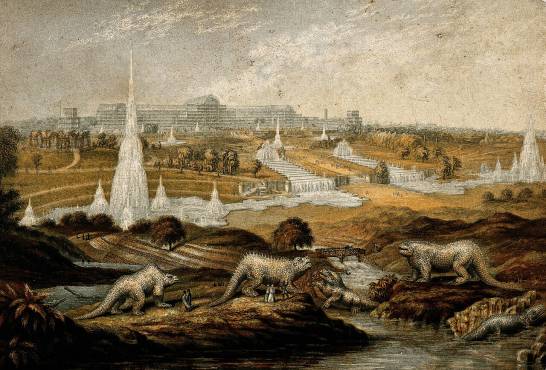
On 31 December 1853, twenty-one people sat down to a New Year's Eve meal in an unusual setting: the hollow interior of a dinosaur. The guests, a mix of scientists, dignitaries and at least one journalist, dined inside an Iguanodon that naturalist sculptor Benjamin Waterhouse Hawkins had built. For them, Sinc reports, the model was an accurate portrait of reptiles that had vanished long before any human had seen one. Hawkins described his task as bringing back to life what had previously been only "dry bones or stones of curious shapes."
Hawkins recreated the Iguanodon, Megalosaurus and Hylaeosaurus — the three dinosaurs known at the time — at full scale, alongside other prehistoric animals, for an exhibition being prepared at the Crystal Palace park in London. To make sure the sculptures matched the science of the day, he took advice from Richard Owen, the scientist who had coined the word "dinosaur" a few years earlier, from Greek for "terrible lizard."
The public response was enormous. Queen Victoria opened the park in June 1854 before a crowd Sinc puts at more than 30,000, and the site went on to draw two million visitors a year. The Crystal Palace itself, destroyed by fire in 1936, was one attraction; the models of the ancient reptiles were the most sought-after. Small-scale replicas were even sold.
From Roman elephants to "terrible lizards"
The first dinosaur fossil had been found nearly two centuries before the dinner, in 1676. It was correctly identified as the end of a femur but confidently attributed to a war elephant from Roman times or to a biblical human giant, according to Sinc. Its resemblance to a pair of testicles earned it the name Scrotum humanum. In 1824 William Buckland used several bone remains to define a prehistoric "lizard," Megalosaurus, to which the puzzling Scrotum was also assigned; that specimen is now lost. In 1841 Owen grouped the megalosaur and two other extinct reptiles already described under a new category: dinosaurs.
Despite being at the frontier of knowledge, Hawkins's models turned out to be badly mistaken. Owen, Buckland and pioneers such as Gideon and Mary Ann Mantell had noticed that the fossils resembled the teeth and bone structures of living reptiles — Megalosaurus means "great lizard," and Iguanodon means "iguana tooth." As paleontologist Steve Brusatte of the University of Edinburgh, author of books on dinosaur evolution and a scientific consultant for the Jurassic World films, told Sinc: "Owen saw dinosaurs as giant primordial reptiles."
The Crystal Palace animals were therefore enlarged, overweight versions of iguanas or monitor lizards: scaly four-legged creatures with an amphibious life, bellies nearly dragging on the ground, sluggish like crocodiles and at home in swamps. None of the three models came close to reality. The Iguanodon was given a horn on its nose like a rhinoceros, a bone that actually belonged to its thumb. The Megalosaurus, the first theropod ever discovered — the predatory carnivore group that later included tyrannosaurs, velociraptors and allosaurs — was sculpted as a hunched iguana, far from its true appearance.
The kangaroo tyrannosaur and the slow, stupid lizard
Updating the look of those predators has been a path full of twists and stumbles, Sinc reports. A clear example is Tyrannosaurus rex, officially described in 1905 by Henry Fairfield Osborn, then president of the American Museum of Natural History. Osborn's original publication showed the animal upright on its hind legs with its tail resting on the ground, kangaroo-style, and the first skeleton was mounted in that pose at the museum in 1915.
The stance was not Osborn's invention. He adopted the bipedal position Joseph Leidy had depicted for his Hadrosaurus, the first dinosaur skeleton reconstructed, mounted in 1868 by none other than Hawkins, the Crystal Palace sculptor. Bipedalism was the first major correction to Hawkins's own models, though at the time it was closer to tripedalism, with the tail serving as a third leg.
For most of the 20th century, Sinc notes, the world knew T. rex and its relatives in that kangaroo posture: monstrous green, scaly lizards in the Godzilla mould, slow and stupid, portrayed as an evolutionary failure. That image, too, would eventually be overturned.
What to watch: as new fossils and analytical techniques continue to emerge, researchers expect further revisions to dinosaur reconstructions — meaning today's most familiar depictions may one day look as dated as a dinner party inside an Iguanodon.