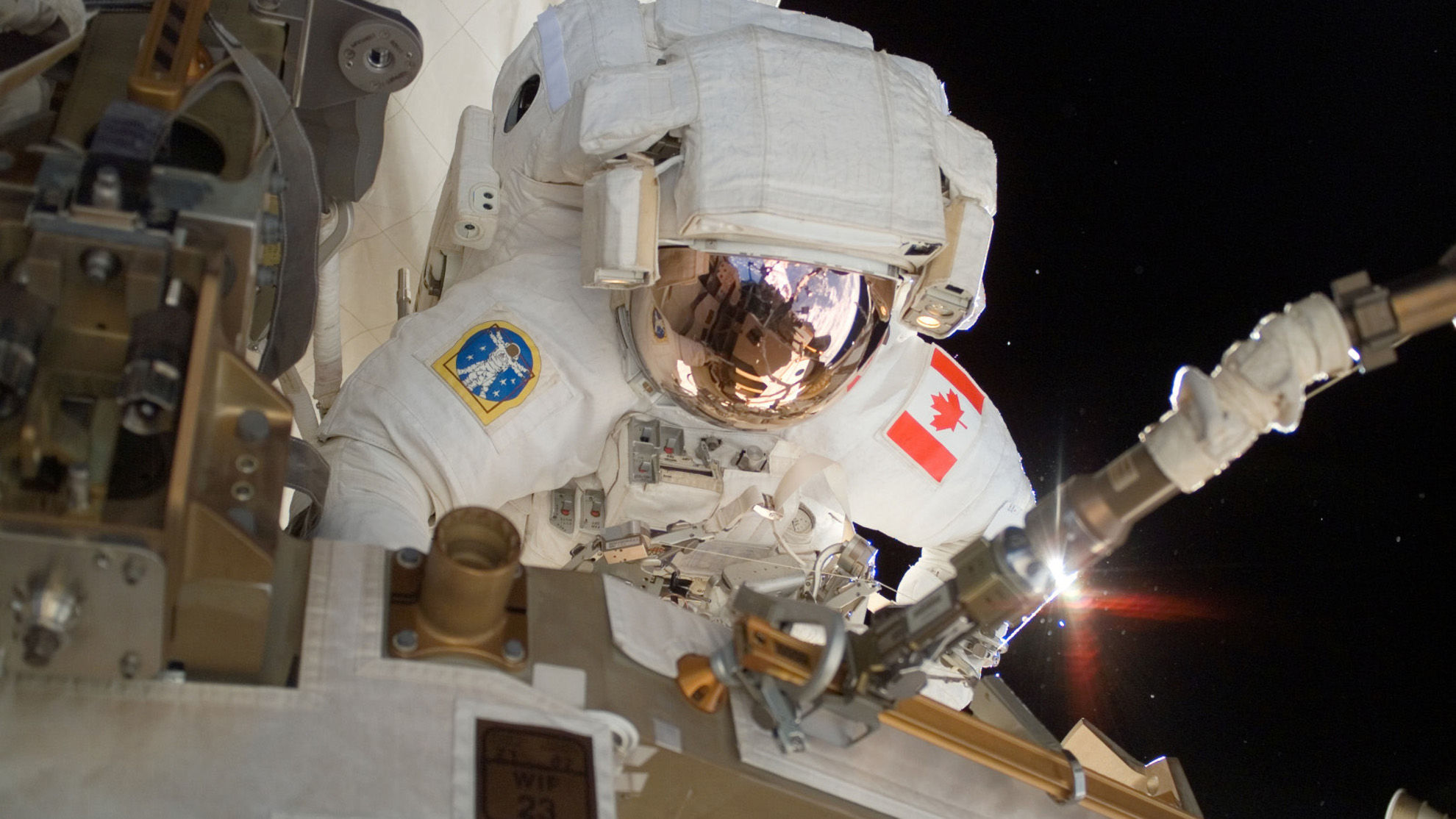
Canadian astronaut Joshua Kutryk is scheduled to step outside the International Space Station for the first time on Thursday, October 29, teaming with NASA astronaut Anil Menon to install a new solar array on the orbiting laboratory's exterior. The spacewalk is set to begin shortly after 8 a.m. EDT, according to The Weather Network, and will be the 100th U.S. spacewalk at the station.
Both men are on their first missions to space. Kutryk, who represents the Canadian Space Agency, has never walked in space before, while Menon has completed three previous spacewalks. The Weather Network reports that Kutryk is less than a month into his stay aboard the station.
The pair will leave through the station's Quest airlock and work outside for about six hours and 45 minutes. Their main task is to install a new International Space Station Roll-Out Solar Array, or IROSA.
Why it matters
The station's power supply depends on a mix of its original solar wings and the newer roll-out arrays added over the past several years. Thursday's work adds another of those units, and a follow-up spacewalk on November 5 is slated to install the eighth and final IROSA. Once both are in place, the station's roll-out array set will be complete.
The milestone also marks a personal first for Kutryk and a rare all-rookie-crew pairing for the station's exterior work, with one astronaut on his fourth excursion guiding a colleague on his first.
How the installation will unfold
According to NASA, as cited by The Weather Network, the two astronauts will begin by freeing the folded solar array from an external pallet. Menon will then attach himself to the station's robotic arm and ride the Canadarm2 to the installation site while carrying the array. Kutryk will stay connected to the station's truss structure and make his own way to the worksite on the port side, where he will join Menon to finish the job. Flight controllers will then power up the new array.
Jessica Watkins and Luke Delaney will support the spacewalk from inside the station, helping the pair into and out of their spacesuits and operating the Canadarm2.
The new array will go into the 2A position. Six IROSAs are already in service at the 1A, 1B, 2B, 3A, 4A and 4B locations, The Weather Network reports. The first pair, at 2B and 4B, went up in June 2021, followed by 3A and 4A in December 2022 and 1A and 1B in June 2023.
Both new arrays reached the station aboard SpaceX's CRS-35 cargo resupply mission, which launched on October 13.
A lighter kind of solar power
Roll-out solar arrays differ from the rigid panels used on most earlier spacecraft. Rigid arrays are folded for launch and then opened in orbit using motors. A roll-out array instead travels coiled on a spool, taking up roughly a quarter of the volume, and unfurls on its own from the energy stored when it was wound, with no motor or gearbox needed. The design is also considerably lighter, which The Weather Network notes makes it a better fit for missions where mass is tightly limited.
Beyond the space station, the technology flew on NASA's Double Asteroid Redirection Test, or DART, the first deep-space mission to rely on roll-out arrays. There they supplied power for the spacecraft's solar electric propulsion system without adding excess weight to its ion engines.
Thursday's spacewalk is scheduled to start just after 8 a.m. EDT. The second installation, at the 3B position, is planned for November 5.