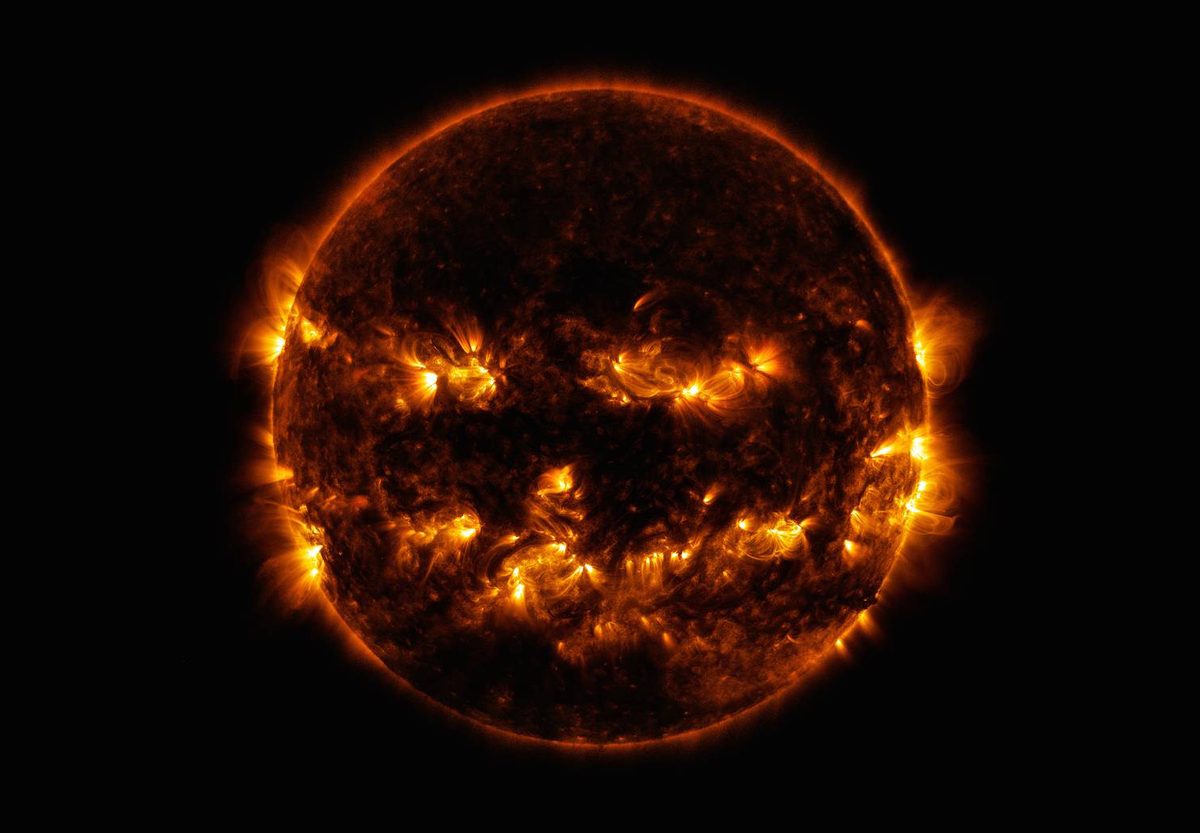
BBC Sky at Night Magazine marked Halloween with a roundup of the eeriest images ever captured of the cosmos, pairing each unsettling shape with the science that produced it. Published on 31 October 2026, the piece gathers views ranging from a solar "jack-o'-lantern" to a ghostly hand and a pair of colliding galaxies that resemble a carved pumpkin. According to the outlet, space agencies have made a habit of releasing such images each Halloween, and the familiar forms they show often trace back to stellar birth, galactic mergers and dying stars.
Why it matters
The roundup makes a simple point: what looks like a fright in a telescope image is usually a physical process playing out on an enormous scale. The magazine argues that behind each apparition sit stories of stars forming, galaxies crashing together and ageing stars casting off their outer layers. Presenting those processes through shapes the eye already recognises gives readers a way into the underlying astronomy.
A Sun that looks carved
The best-known example in the collection is an image of the Sun taken by NASA's Solar Dynamics Observatory, which watches the star from orbit around Earth. The picture has circulated widely over the years as the "NASA Halloween Sun" because its bright patches trace a face resembling a carved pumpkin.
Those patches are active regions, where strong magnetic fields sit in the corona, the Sun's outermost atmospheric layer. They look brighter than their surroundings because they give off more light and energy. The image combines two extreme ultraviolet wavelengths, 171 and 193 ångströms, which are usually shown in gold and yellow tones. Reprocessing the same observation at different wavelengths, the magazine notes, yields a completely different portrait; viewed at 171 ångströms alone, the scene takes on a golden-yellow cast that brings the surrounding solar surface into sharper view.
A hand made of magnetism
A second image assembles data from three observatories: NASA's Chandra X-ray Observatory, the Imaging X-ray Polarimetry Explorer (IXPE) and the Dark Energy Camera Plane Survey (DECaPS2). Together they show a structure that reads as a spectral hand. It is in fact a pulsar wind nebula, MSH 15-52, wrapped around a spinning neutron star known as pulsar PSR B1509-58. Chandra first observed the pulsar in 2001.
The composite draws on orange, green and blue from Chandra, a diffuse purple from IXPE, and red and blue from the Dark Energy Camera. IXPE's contribution let astronomers chart the nebula's magnetic field for the first time by tracing the orientation of X-ray electric fields. Those measurements appear as short straight lines, with orange marking the most precise readings and cyan and blue the least. The mapping, according to the magazine, sharpens the hand-like impression.
A star shedding its layers
CW Leonis, a red giant roughly 400 light-years away in the constellation Leo, appears wrapped in thick cosmic dust. The star has started to cast off its outer layers as it runs short of the hydrogen needed to sustain itself. Without the outward push that once balanced its own gravity, it begins to collapse inward. A shell of plasma around its core then heats up, driving the outer layers to expand and fling out large amounts of gas and dust.
In the published image, an orange glow cuts through the dust, which the magazine compares to a lantern shining through autumn mist.
Two galaxies, one face
A Hubble Space Telescope image shows what looks like a jack-o'-lantern with glowing eyes and a lopsided smile. The "eyes" are two galaxies, NGC 2292 and NGC 2293, in the constellation Canis Major, in the early stages of merging under strong gravitational pull.
A galactic collision sounds violent, but stars within galaxies are spaced so widely apart that they are very unlikely to strike one another. What the gravitational contest does instead is stir up interstellar gas and dust, setting off bursts of new star formation. The pumpkin-orange light across the frame comes from older red stars in both galaxies. The crooked smile near the bottom is probably a new spiral arm being born as gas was compressed in the merger's opening phase.
A further Hubble image, also released for Halloween, shows a ghostly face with two bright eyes. That object is another interacting pair of galaxies, catalogued as Arp-Madore 2026-424 (AM 2026-424).
The full collection, with the science behind each image, is available in the magazine's article.





