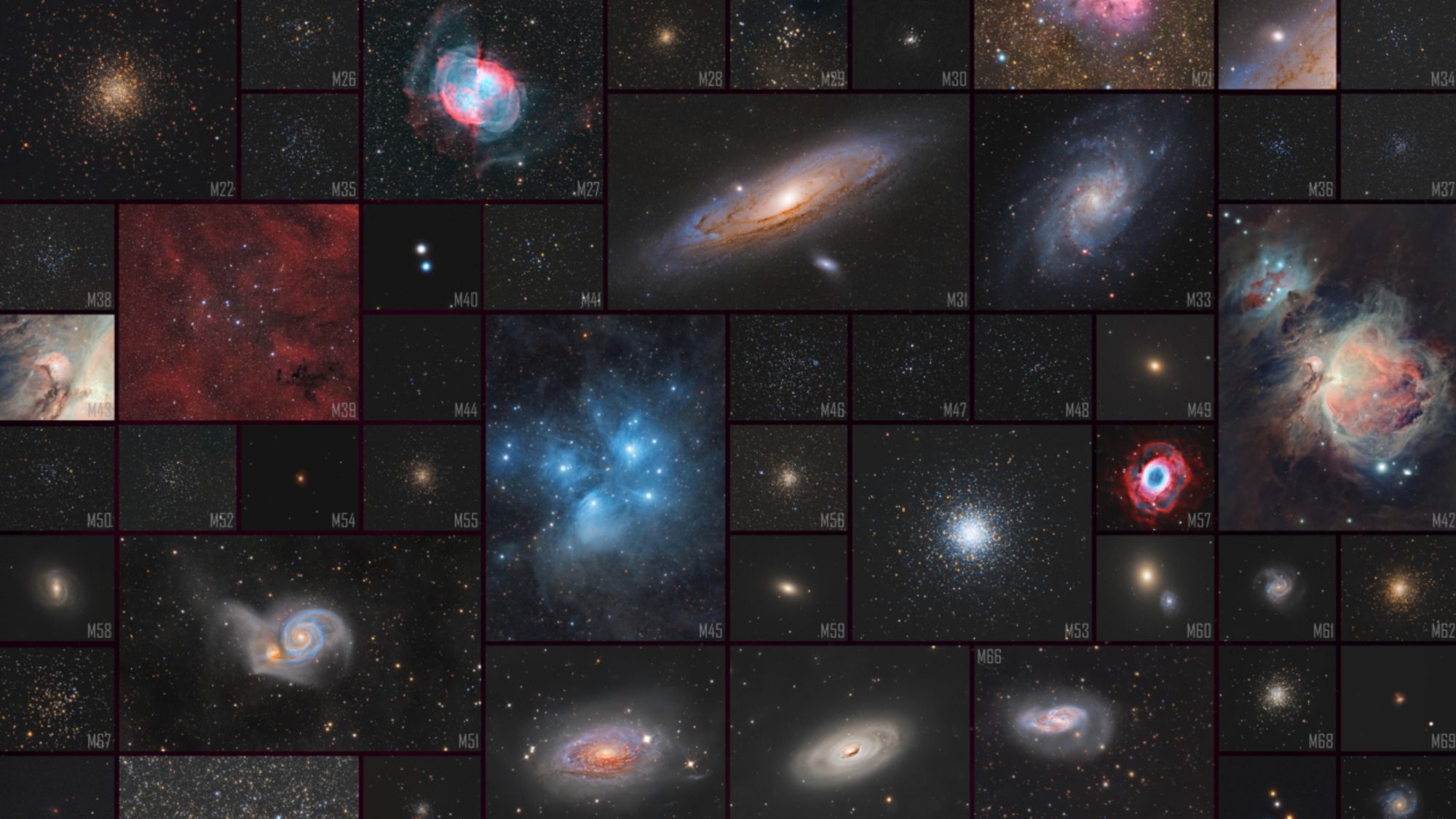
Amateur astrophotographer Cornelis van Zuilen has assembled a single mosaic containing all 110 galaxies, star clusters and nebulas listed in the Messier catalog, Space reports. The project consumed 352 hours and 13 minutes of imaging time and, according to Space, required him to sleep in his car on numerous nights.
Van Zuilen, who lives in the town of Heiloo in the Netherlands, told Space.com by email that he began the effort roughly a year and a half ago. His first Messier target, he said, was the Pleiades star cluster, also known as Messier 45, which he shot in 2024 shortly after buying his first cooled deep-sky camera.
The final image is a collage in which the individual objects appear at different sizes. Van Zuilen told Space that the larger frames are his personal favorites, and that most of them carry a story about how they were made, something he said gives the collage extra meaning for him.
Why it matters
The Messier catalog is one of the oldest and most widely used observing lists in astronomy, and it remains a standard starting point for people learning to photograph the night sky. Completing all 110 entries from a densely populated and light-polluted corner of Europe, rather than from a remote dark-sky site, shows what sustained effort and repeated trips to nearby fields can achieve with modest equipment.
The scale of the project also sets it apart. Space describes the effort as taking hundreds of hours across many nights, a total that places it well beyond the typical single-object astrophotography session.
A catalog built to catch comet hunters
The list traces back to the 18th-century French astronomer Charles Messier, who, according to NASA, compiled it to record deep-sky objects that could be confused with comets because of the way they glow. The catalog has been revised several times since, and it now includes some of the best-known objects visible from the Northern Hemisphere, among them the Andromeda Galaxy (M31), the Pleiades (M45) and the Orion Nebula (M42).
Space notes that every object on the list can be seen through a modest backyard telescope when the sky is dark, which is why the catalog has become a familiar checklist for amateur astronomers working through the sky beyond the solar system.
Equipment, software and a balcony with a problem
Van Zuilen captured the ancient light with an Askar 103APO telescope and a William Optics Redcat 51 MK2.5, using a range of ZWO astronomy cameras and filters, Space reports. He then processed each object individually in Photoshop and the astronomy software PixInsight before combining them.
Much of the imaging happened from his own balcony. Other targets forced him to move his gear, because trees and farm buildings blocked the low horizon he needed.
"Doing this from the Netherlands was quite a challenge," van Zuilen told Space. He explained that he frequently drove to a semi-dark field close to home for an unobstructed view, which led to the nights spent sleeping in his car. He added that he enjoyed that part of the process and compared it to camping.
The Netherlands is one of the most light-polluted countries in Europe, and its northern latitude limits how much of the sky is accessible and for how long. Those conditions shaped how the project had to be scheduled, with repeated trips and long waits between usable nights.
What to watch
Space's write-up of the mosaic sits alongside its beginner's guide to photographing the night sky and its recommendations for cameras and lenses suited to the hobby, and the outlet invites readers to submit their own astrophotography for possible publication. For anyone considering a similar catalog-wide project, van Zuilen's approach — one object at a time, processed separately, then assembled — offers a template that does not depend on access to a professional observatory.





