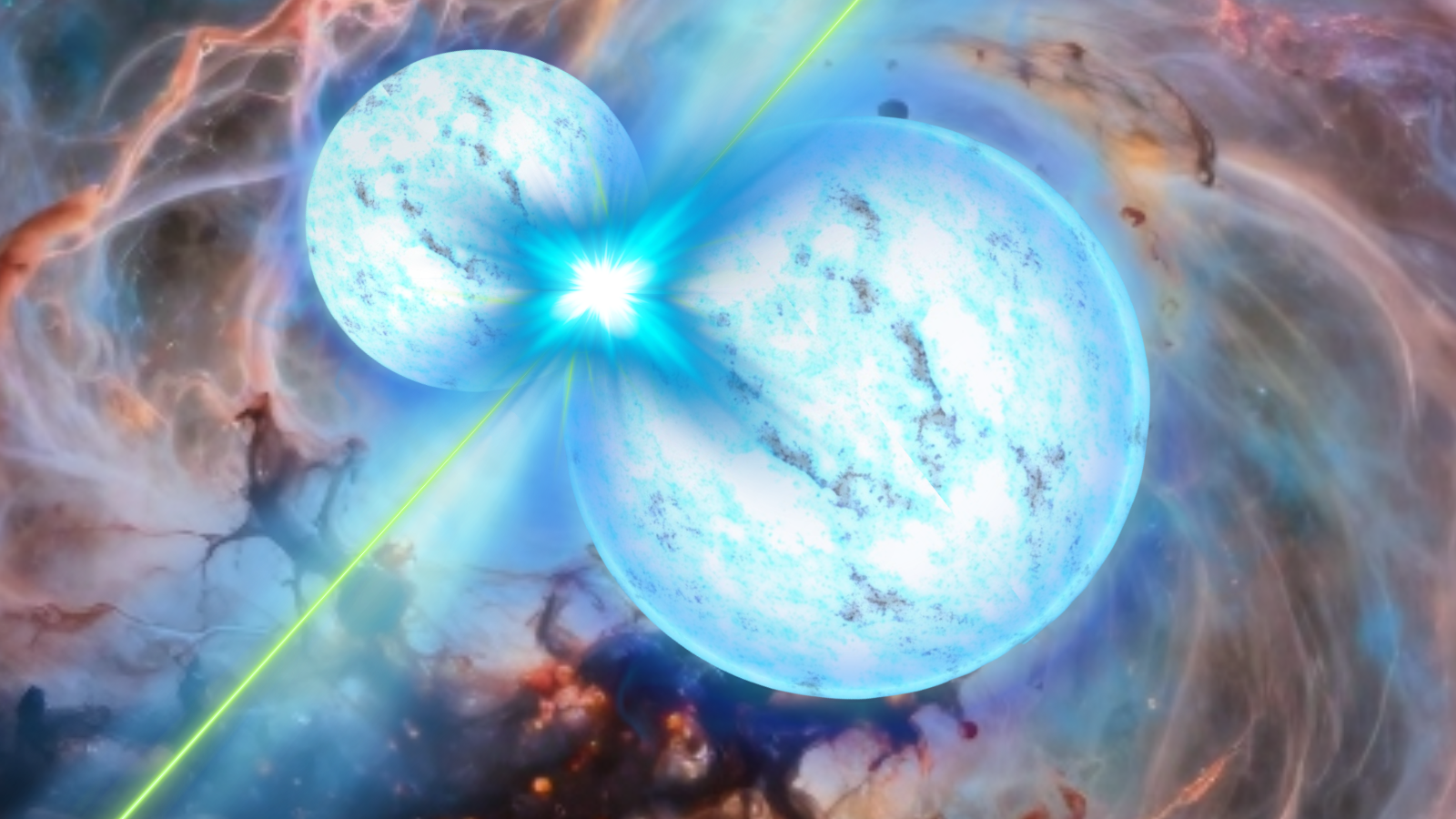
Astronomers studying an unusually long-lived burst of X-rays from a distant galaxy believe the flash may have been produced when two dead stars smashed together, according to Space. The event, catalogued as EP250704a, was first detected on July 4, 2025, as a half-second pulse of gamma rays followed by a bright X-ray glow that persisted for roughly 10 minutes.
The initial alert came from the Einstein Probe, a joint European-Chinese mission, after which a team of researchers began examining the explosion's aftermath with the European Southern Observatory's Very Large Telescope (VLT), the Very Large Array (VLA), and other instruments. Space reports that the outburst did not resemble any previously recorded event of its kind.
Niccolò Passaleva, the astronomer who led the VLT observations of the X-ray flash, described the burst as the longest-lasting prompt X-ray emission ever seen from a neutron star merger. In a statement, he said the event offered a chance to observe the universe's most extreme forces up close and to learn more about how they work.
Why it matters
Neutron stars form when massive stars collapse and explode as supernovas, packing one to two times the mass of the sun into a sphere roughly the width of a city. Space notes that the material is so dense that a single teaspoon of it would weigh about 10 million tons on Earth. When two such objects collide, the resulting environment is violent enough to forge heavy elements that ordinary stellar cores cannot produce — including the gold found in jewelry.
These mergers, marked by light displays known as kilonovas, have long been tied to gamma-ray flashes that fade within about two seconds. The new research suggests, however, that some neutron star collisions may announce themselves through X-ray blasts lasting minutes rather than seconds, which would change how astronomers search for and interpret them.
A hidden X-ray phase
Since its launch in 2024, the Einstein Probe has detected hundreds of X-ray flashes in far-off galaxies, and scientists have debated what causes them. Some have been traced to supernova explosions that leave behind a neutron star or a black hole, while others have resisted explanation. EP250704a belongs to the unexplained group, according to Space.
Eleonora Troja, a member of the Einstein Probe European collaboration, said in a statement that the X-ray data from the event immediately signaled that something unusual was happening.
The team's working explanation centers on what the merger left behind. All neutron stars are born the same way, from the collapsing core of a massive star, but they do not all end up alike. As a stellar core shrinks, it spins faster — the same principle that speeds up a figure skater who pulls in their arms — and the rotation rate of the resulting neutron star can exceed 700 turns per second. The collapse also compresses magnetic field lines, intensifying the field. A core that already carried a strong magnetic field can therefore produce a neutron star with the most powerful magnetic field known in the universe. Such objects are called magnetars.
The researchers suspect that at least one magnetar was involved in the merger behind EP250704a. Troja explained that if the collision's remnant is a magnetar, it could continue erupting for longer, because magnetars are fast-spinning neutron stars whose enormous magnetic fields, when released into their surroundings, can make an explosion brighter and more drawn out.
The team ruled out a supernova as the source of the X-ray burst and determined that the light from the collision had been traveling toward Earth for 6 billion years, Space reports.
What to watch
Passaleva said that finding more of these extreme X-ray flashes could help astronomers work out how often magnetars are created through neutron star mergers.





