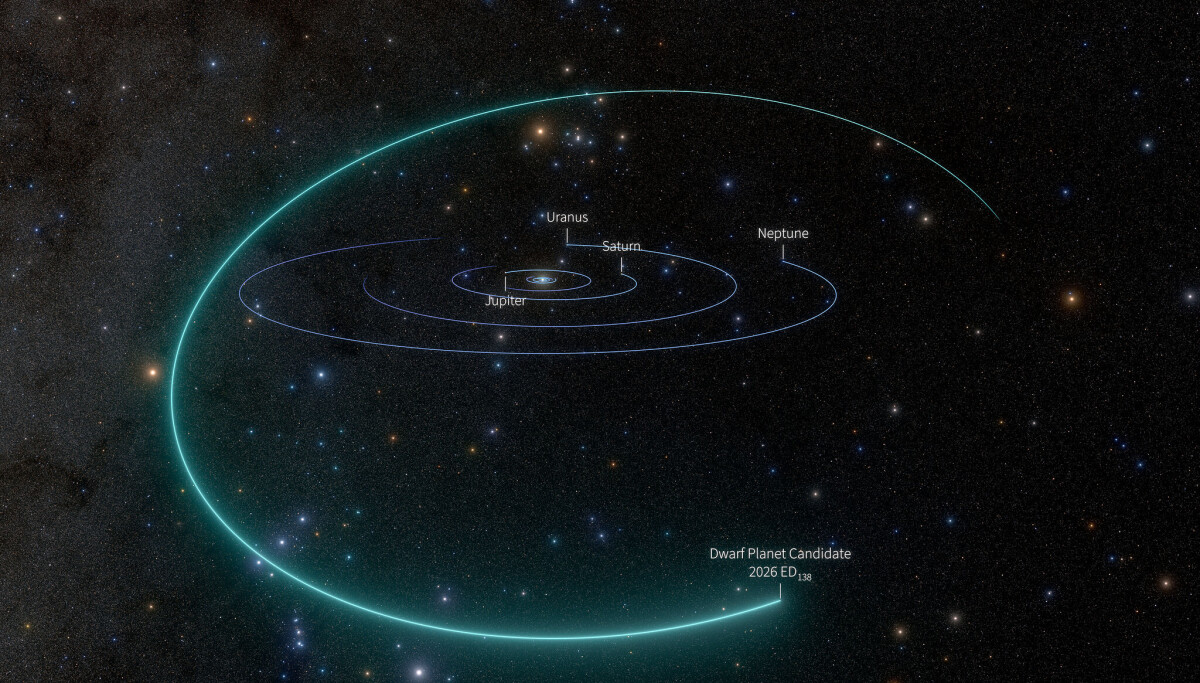
Astronomers working at the Vera C. Rubin Observatory in Chile have identified a candidate dwarf planet that may have been orbiting the Sun unnoticed, Universitetsavisa reports. The object, designated 2026 ED138, was announced by the research team at a conference in Spokane, Washington, this week.
According to the outlet, the body is estimated to measure between 600 and 1,500 kilometres in diameter and follows a path around the Sun roughly 46 times wider than Earth's orbit. For comparison, Pluto sits about 40 times farther from the Sun than Earth does.
The candidate lies in the Kuiper Belt, the distant and still poorly understood region at the edge of the solar system. The discovery was made at the new observatory on Cerro Pachón, a mountain site in Chile.
Why it matters
If confirmed, the object would join the small group of known dwarf planets — a classification that depends on more than size alone. Researchers must now determine whether 2026 ED138 meets the criteria for the category before any formal designation is made, according to Universitetsavisa.
Paul Byrne, a professor of astronomy at Washington University in St. Louis, told National Geographic that the find points to a broader shift in the field. He described the discovery as very exciting and said it signals a new era in solar system and planetary research.
Byrne also linked such finds to the bigger question of origins. Each discovery of this kind, he said, brings researchers a step closer to understanding how our planetary system came into being.
A distant neighbour in the Sun's family
Although the object is not among Earth's closest neighbours, it circles the same star as we do. Its orbit, about 46 times the width of Earth's, places it well beyond the planets of the inner and outer solar system and in the range where icy bodies are common.
The size estimate — a lower bound of 600 kilometres and an upper bound of 1,500 — leaves open exactly how the object should be classified. The dwarf planet label is applied to bodies that orbit the Sun and are massive enough to be rounded by their own gravity, but that have not cleared their orbital neighbourhood of other material. Whether 2026 ED138 fits that definition is a question the researchers will have to settle.
Pluto, the best-known dwarf planet, offers a useful yardstick for distance: it orbits at roughly 40 times Earth's distance from the Sun, slightly closer in than the newly reported candidate.
An observatory built to find faint objects
The detection came from the Vera C. Rubin Observatory, a new facility on Cerro Pachón in Chile. The site's instruments are designed to survey the sky repeatedly and pick up dim, slow-moving objects that earlier searches may have missed — the kind of body that could sit in the outer solar system without drawing attention.
Universitetsavisa reports that the team presented the finding at the Spokane conference this week. The outlet notes that the Kuiper Belt remains a mysterious part of the solar system, and that objects like this one are central to efforts to reconstruct how the planets formed.
The path from candidate to confirmed dwarf planet runs through follow-up work: additional observations to pin down the object's size, shape and orbit, and a formal review of whether it satisfies the classification rules. Until then, 2026 ED138 remains a candidate.
What to watch is whether the researchers can confirm the object's physical properties and submit it for recognition as a dwarf planet — a decision that would add a new member to a very short list.





