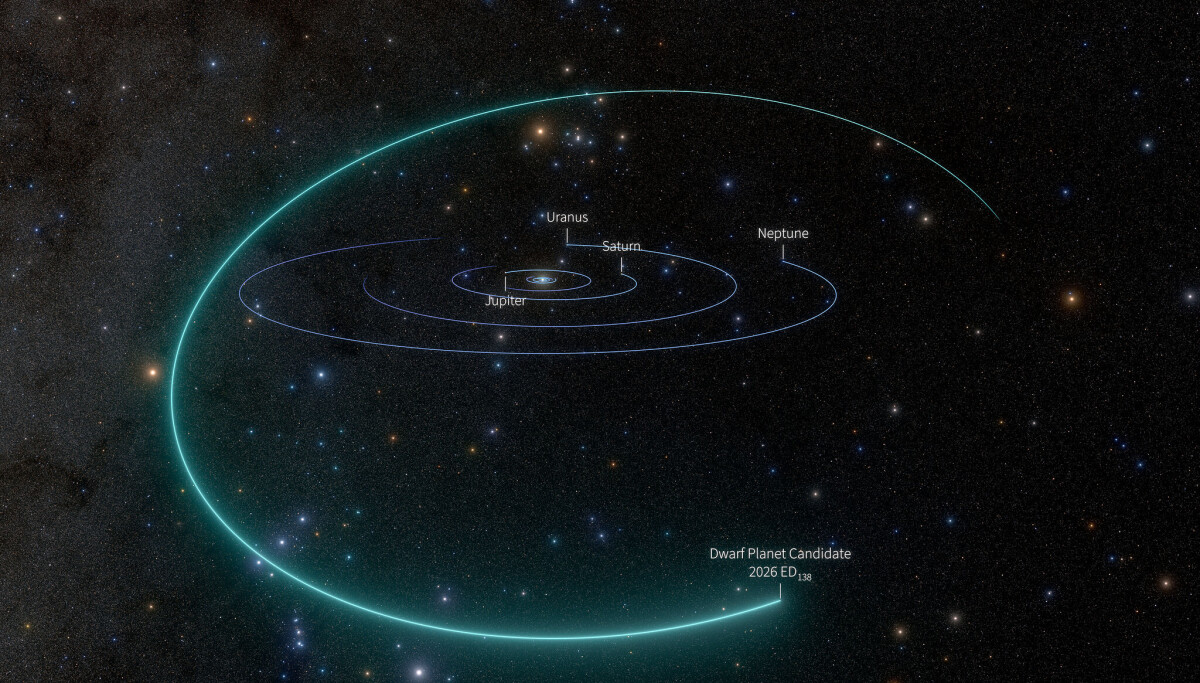
Astronomers working at the Vera C. Rubin Observatory in Chile have identified a candidate dwarf planet that had gone unnoticed until now, according to Universitetsavisa. The object, designated 2026 ED138, is believed to measure between 600 and 1,500 kilometres in diameter and circles the same Sun as Earth, though on a far wider path.
The team presented the finding this week at a conference in Spokane, Washington, Universitetsavisa reports. The observatory sits atop Cerro Pachón in Chile.
According to the report, the object's orbit is roughly 46 times wider than Earth's. For comparison, Pluto orbits at about 40 times Earth's distance from the Sun. The body lies in the Kuiper Belt, the distant, still poorly understood region at the outer edge of the solar system.
Why it matters
The discovery, if confirmed, would add a candidate to the small roster of known dwarf planets and would come from a facility built specifically to survey the sky at scale. Universitetsavisa frames the find as a possible opening of a new phase in the study of the solar system and its planets.
Paul Byrne, a professor of astronomy at Washington University in St. Louis, told National Geographic that the object is "incredibly exciting" and signals a new era in solar-system and planetary research, according to Universitetsavisa. Byrne also said each discovery of this kind brings researchers closer to understanding how our planetary system came to be.
The Kuiper Belt itself remains a frontier. Universitetsavisa describes it as a part of the solar system that has so far been shrouded in mystery, which makes any new object found there a useful data point for models of how the outer solar system formed and evolved.
What is known about 2026 ED138
The reported facts are limited. The object's size range — 600 to 1,500 kilometres across — is an estimate, and the gap between the low and high ends is wide enough that the body's physical nature is not yet pinned down. Whether it is massive enough to have pulled itself into a roughly round shape, a common criterion for dwarf-planet status, is among the questions the researchers will need to address.
Its distance is stated in relative terms: an orbit 46 times wider than Earth's, slightly beyond Pluto's mean distance from the Sun. That places it firmly in the Kuiper Belt, the zone of icy bodies beyond Neptune.
The name 2026 ED138 is a provisional designation rather than a permanent one, consistent with how newly found solar-system objects are catalogued before their orbits are confirmed.
Universitetsavisa reports that it now falls to the researchers to determine whether the object should be formally proposed for dwarf-planet status. That process involves more than a single observation: an object's orbit must be tracked well enough to establish its path, and its size and shape must be characterised before a classification can be settled.
The announcement was made at a conference rather than in a peer-reviewed paper, according to the report, which means the details presented are preliminary.
A survey instrument built for finds like this
The Vera C. Rubin Observatory is a new facility, and Universitetsavisa attributes the detection to researchers working there. The observatory's location on Cerro Pachón in Chile gives it access to the southern sky, and its work is aimed at repeated, wide-field imaging — the kind of programme that turns up faint, slow-moving objects that earlier surveys missed.
That context matters for how the finding should be read. A single candidate dwarf planet is a notable result on its own, but it is also a signal about the instrument's reach. If the observatory is already producing objects of this size class early in its operation, more candidates are likely to follow, and the question of how many dwarf planets the outer solar system holds may shift from a matter of speculation to one of cataloguing.
Byrne's remark to National Geographic, as reported by Universitetsavisa, points in the same direction: the value of such finds lies less in any single body than in what a growing sample reveals about the system as a whole.
What to watch
The immediate next step is confirmation. Researchers will need to refine the object's orbit and better constrain its size before any formal case for dwarf-planet status can be made. Watch for follow-up observations of 2026 ED138 and for further candidate announcements from the Rubin Observatory as its survey continues.





