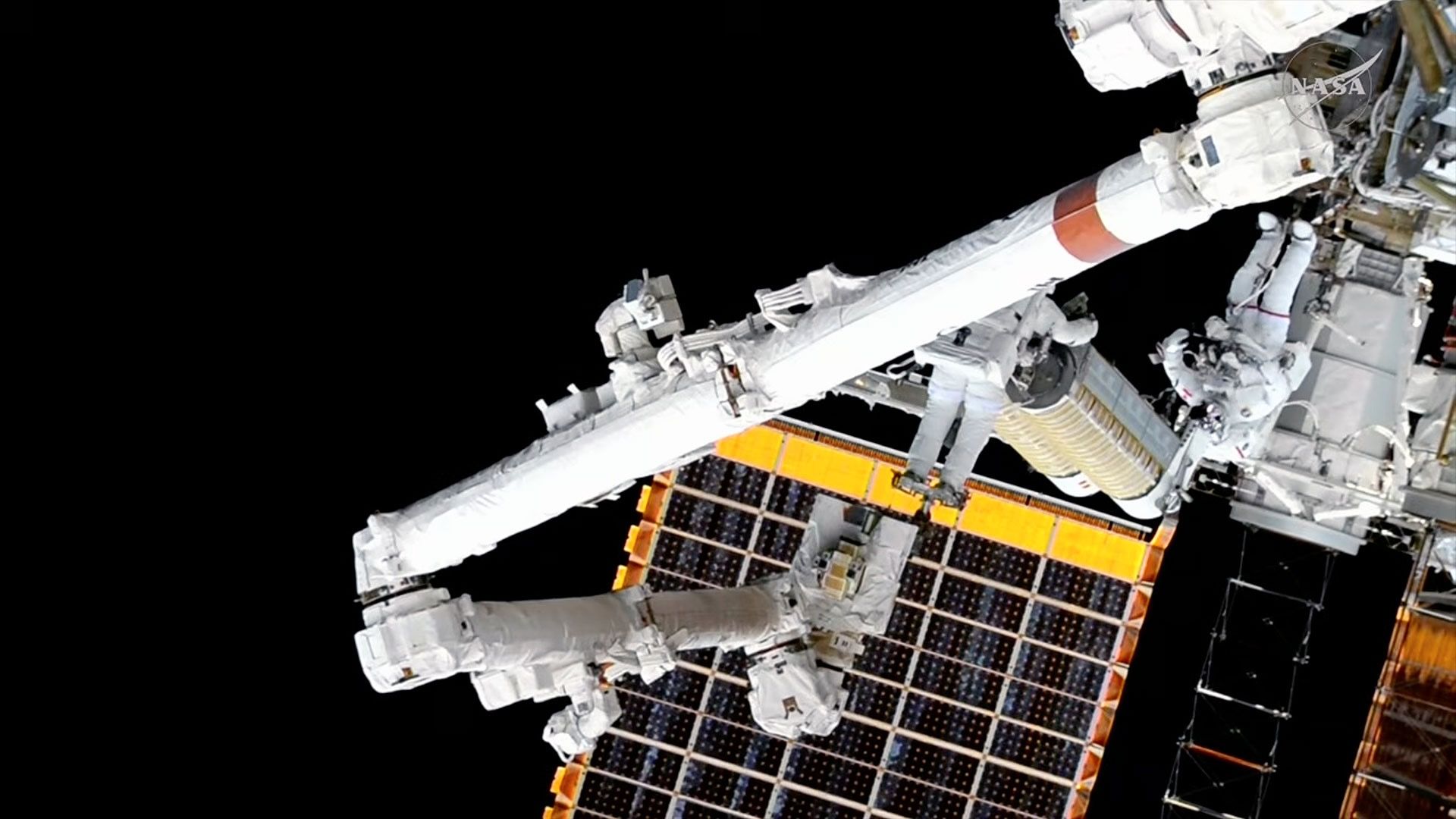
NASA astronaut Anil Menon and Canadian Space Agency astronaut Joshua Kutryk installed and unfurled the eighth and final International Space Station Roll-Out Solar Array (iROSA) during a spacewalk on Thursday, Nov. 5, 2026, according to Space. The extravehicular activity ran 6 hours and 59 minutes, beginning at 8:36 a.m. EST and ending at 3:35 p.m. EST, the outlet reported. The new array is expected to raise the station's power output by as much as 30 percent.
The two Expedition 75 flight engineers worked on the starboard side of the station's truss backbone at the 3B power channel. They pulled the 750-pound (340-kilogram) array assembly from a temporary stowage platform, moved it to the worksite using the Canadarm2 robotic arm, and secured it to a bracket kit that had been assembled on an earlier spacewalk.
Why it matters
The station's eight original solar array wings have been producing less electricity as they passed their 15-year design life, a decline flight controllers identified before the replacement campaign began. The iROSAs are meant to supply the additional power the station needs through its planned retirement and controlled deorbit, currently set for late 2030, Space reported.
The work also closes out a program that spanned several years and multiple crews. The eight arrays and their mounting hardware all arrived aboard SpaceX Dragon cargo spacecraft, with installation beginning in June 2021.
A current reading, a wait, and a clean deployment
After Menon connected the cables linking the new array to station systems, Mission Control saw a problem. Spacewalk officer Nichole Stilwell, a NASA astronaut, radioed that only half the expected shunt current was registering and that deployment would not proceed in that configuration, according to Space.
The connectors needed to be checked, but the arrays generate electricity whenever sunlight strikes them, so the astronauts had to wait for the station to pass into Earth's shadow before inspecting them. They used the time to tidy their worksite and return Canadarm2 to its parking position, the same steps they would have taken after a deployment.
Once in darkness, the issue was resolved. Stilwell reported good shunt currents on the ground and gave the go-ahead to deploy. Kutryk and Menon released two bolts and watched the array extend to its full 63 feet (19 meters). No motor was involved: the iROSA unrolls using only the stored energy of its rolled carbon composite booms, and the process took about 10 minutes, Space reported.
"Today marks the completion of not just one solar array but, over 15 years after its development, eight arrays," Menon said at the end of the spacewalk, per Space. He described the new arrays as half the size of the originals while delivering 40 percent more power.
Crews behind the eight arrays
Four pairs of astronauts carried out the installations. Shane Kimbrough of NASA and Thomas Pesquet of the European Space Agency handled the 2B and 4B channels; NASA's Josh Cassada and Frank Rubio installed arrays on 3A and 4A in December 2022; NASA's Steve Bowen and Woody Hoburg covered 1A and 1B in June 2023; and Kutryk and Menon completed the 2A and 3B channels this year.
Stilwell congratulated the pair in remarks relayed by Space, noting that the station had just passed 26 years of continuous human presence and praising the crew for carrying out difficult and dangerous work. Menon now has 33 hours and 30 minutes across four spacewalks; Kutryk has 14 hours and 10 minutes across two.
Thursday's EVA was the 101st U.S. spacewalk at the station conducted without a space shuttle present and the 286th overall in support of station assembly, maintenance and upgrades. It was the ninth spacewalk of 2026 and the sixth by the Expedition 75 crew.
With the array deployment complete, attention turns to the station's end of life, with retirement and controlled deorbit currently planned for late 2030.