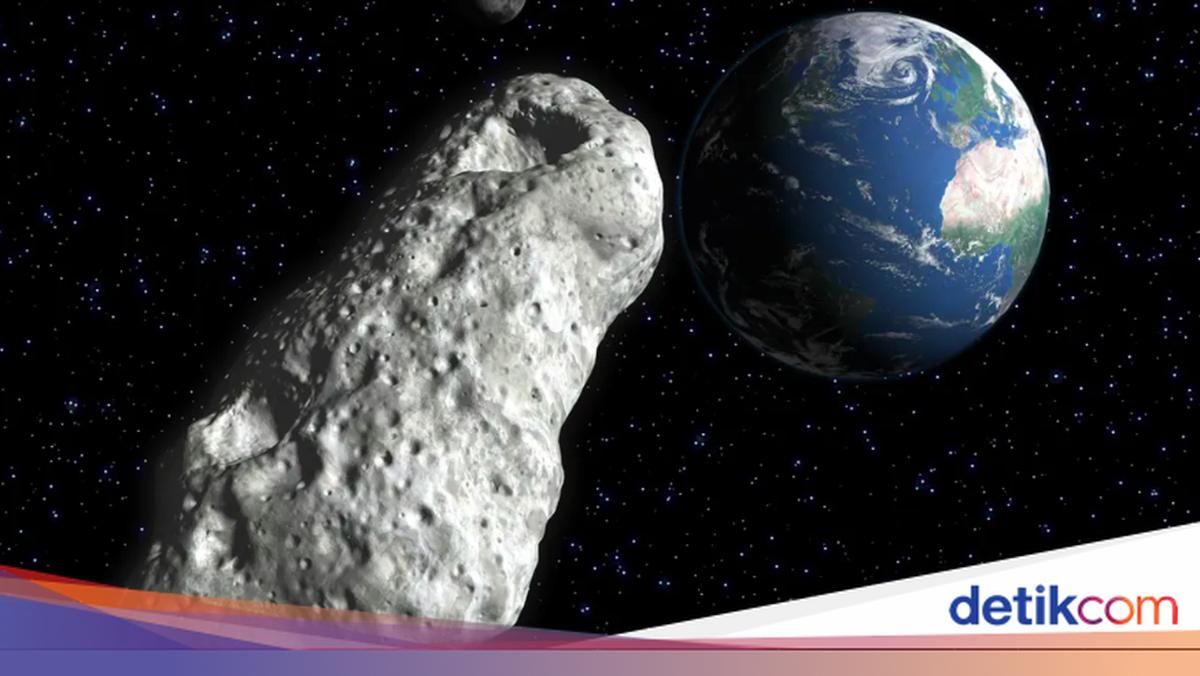
Earth briefly gained a second natural companion in space. A small asteroid designated 2026 QQ8 was captured by the planet's gravity and has been circling Earth as a temporary mini-moon, according to detikInet. The object, roughly one meter across, entered Earth's gravitational influence in late April 2026 but was not spotted until several months later.
Hungarian astronomer Krisztián Sárneczky discovered it on 20 August 2026 using a telescope at the Piszkéstető Observatory in Hungary, detikInet reports, citing The Daily Galaxy. On 29 October 2026, the Minor Planet Center (MPC) announced that orbital calculations confirmed the object is temporarily bound to Earth.
Why it matters
Mini-moons are natural laboratories. Because they pass relatively close to Earth, scientists can study near-Earth asteroids — their physical properties and origins — from a shorter distance than most deep-space objects allow. The 2026 QQ8 episode also shows how quickly small objects can slip into Earth's neighborhood unnoticed, and how follow-up observations can settle questions about what they actually are.
The case carried an extra wrinkle: for a time, astronomers could not rule out that the object was human-made debris, such as a spent rocket fragment. That uncertainty shaped the investigation that followed.
From suspect debris to confirmed asteroid
To determine the object's origin, astronomers ran additional observations with more powerful telescopes in Hawaii and Arizona. They also examined how solar radiation pressure — the slight push exerted by sunlight — affected the object's motion. That pressure can nudge the paths of small space objects, making it a useful diagnostic.
After reviewing the evidence, the MPC concluded the object was not artificial. According to detikInet, the center stated that no connection to any known human-made object had been found.
That settled it: 2026 QQ8 is natural, most likely a small asteroid that happened to pass close enough to be caught. At about one meter in size, it poses no meaningful threat. Even if it entered Earth's atmosphere, it would be expected to burn up and produce a bright streak known as a fireball.
A short stay and an untidy path
Unlike the Moon, which has orbited Earth for billions of years, 2026 QQ8 holds its mini-moon status only temporarily. It is expected to remain under Earth's gravitational pull until December 2026, after which it will break free and resume its journey around the Sun in 2027.
Its route is nothing like the Moon's neat circle. The asteroid follows an irregular path as it moves around both Earth and the Moon before heading back out into interplanetary space.
Notably, 2026 QQ8 never came especially close to Earth. Its closest orbital approach is estimated at about 570,000 kilometers — roughly 1.5 times the average Earth-Moon distance, detikInet reports.
This is also not the asteroid's first pass by Earth. Orbital reconstructions indicate it approached the planet in 1965 and is expected to return in 2058, though neither of those encounters resulted in gravitational capture.
Mini-moons are not a new phenomenon. Earth has hosted similar objects before, including asteroids 2020 CD3 and 2024 PT5, which lingered near the planet for periods of time. Astronomers distinguish these from quasi-moons, which actually orbit the Sun but follow paths that make them appear to travel alongside Earth. Because 2026 QQ8 is genuinely held by Earth's gravity, it belongs in the mini-moon category.
Watch for the MPC's orbital updates as 2026 QQ8 approaches its December departure, and for the object's next predicted pass in 2058.





