India's Aditya-L1 solar observatory has gathered evidence that large eruptions from the Sun can grow unevenly as they move through space, according to a study reported by INDIA New England News. Researchers at the Indian Institute of Astrophysics (IIA) found that coronal mass ejections — vast clouds of magnetized plasma thrown off by the Sun — do not always expand in a uniform way. The work was published in The Astrophysical Journal Letters.
The finding matters because these eruptions are a leading cause of space weather. When a coronal mass ejection heads toward Earth, it can set off geomagnetic storms that disturb satellite operations, radio links and navigation systems. Knowing how an eruption changes shape and speed along its path is central to estimating when disruptive solar activity might arrive.
Why it matters
Forecasting models have often treated an expanding coronal mass ejection as a fairly simple, evenly growing cloud. The IIA results, described by India's Ministry of Science and Technology, push back on that assumption and suggest the picture is more complicated, INDIA New England News reports.
That difference has practical consequences. A cloud that widens more on one side than the other will meet the surrounding solar wind differently, and those interactions can alter its pace. Small errors in estimated speed translate into larger errors in arrival time, which is the number satellite operators and power grid managers most need.
What the observations showed
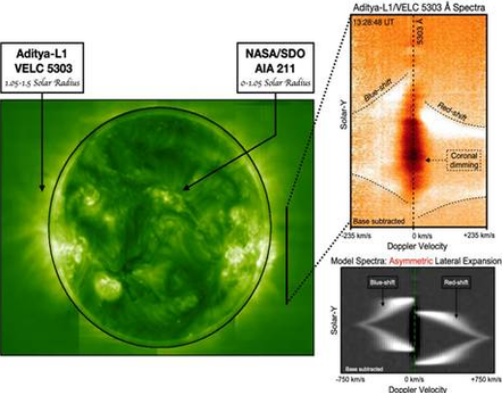
The team drew on the Visible Emission Line Coronagraph (VELC), the main instrument aboard Aditya-L1, and combined it with data from NASA's Solar Dynamics Observatory. The researchers then built three-dimensional computer models to reconstruct the eruption's geometry and track how it spread in various directions.
According to the reporting, the analysis indicated that lopsided sideways growth, together with the orientation of the eruption, could account for spectral patterns picked up by VELC. The team examined an event observed on August 5, 2024, as covered in the source reporting.
Jayant Joshi, an IIA researcher and co-author of the study, explained the consequences in comments carried by INDIA New England News. He said the uneven early shape of an eruption can shape how it meets the solar wind and how much drag it encounters as it crosses the heliosphere — the broad region of space shaped by the Sun's wind and magnetic field. Those effects, he added, can change the cloud's speed and, in the end, when it reaches Earth.
Why a single spacecraft can do this work
Aditya-L1 launched in September 2023 and is positioned near the Sun-Earth L1 Lagrange point, a gravitational balance point that lets the craft keep a continuous view of the Sun. It carries seven scientific instruments. VELC, the primary payload, studies the corona — the Sun's outer atmosphere — using several measurement methods at once.
Observing close to the Sun is valuable because that is where an eruption undergoes fast shifts in shape, speed and direction. Conventional imaging alone cannot always settle whether a cloud is moving toward or away from the observer. By pairing spectral readings with three-dimensional modeling, the researchers were able to rebuild the eruption's motion without relying entirely on pictures taken by several spacecraft from different angles, according to the reporting.
The IIA group now intends to apply the same technique to other eruptions to see whether uneven expansion is common or rare. The researchers believe the method can work alongside existing space-based observations and add detail to the picture of how these clouds develop in their earliest stages.
More accurate warnings of solar disturbances could give operators of satellites, communication networks and navigation services time to prepare as those systems take on growing roles in daily life. Watch for follow-up studies from the IIA team testing whether other coronal mass ejections show the same lopsided growth.